Get Full Government Meeting Transcripts, Videos, & Alerts Forever!
Get email alerts on the Workforce And Higher Ed Programs topic
No spam. Unsubscribe anytime.
LCCC highlights health-care, trades and transfer programs; asks Cheyenne for internships, housing and transit support
Summary
Laramie County Community College presented growth in health-care and trades programs, a transfer agreement and an 'Accelerate' dual-enrollment program; President Joe Schafer asked the city for help with internships, transit and housing to retain and recruit students.
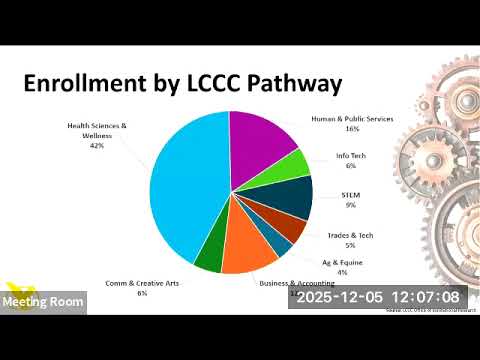
Laramie County Community College officials told the Cheyenne City Council their largest enrollment concentrations are in health-care programs—about one in three students—and that trades, cybersecurity and applied programs are expanding. President Joe Schafer described new and expanded offerings from respiratory therapy to diagnostic medical sonography, a practical nursing (LPN) pathway tailored for workers in small facilities, and the largest nursing program in the state with about 176 students.
Schaefer said the college is adding capacity—more cohorts in welding and a second automotive cohort—and emphasized challenges recruiting qualified instructors because practitioners often command higher private-sector wages.
On transfer and access, Schafer described an Express Transfer Agreement that uses dual admission and shared advising with the university to raise transfer rates for students who otherwise complete two years but do not continue to a four-year campus. He also summarized 'Accelerate,' a dual/concurrent enrollment pilot that deepens career exploration in high schools, aims to reduce inequities in access to concurrent credit, and offers a full first year of tuition-free enrollment at LCCC for program graduates who enroll.
Schaefer invited the council to partner on applied learning and internships, and asked municipal leaders to consider how downtown housing, transit and amenities factor into students' choices. He said about 450 students live on campus now and the college seeks to reach roughly 600 in residence halls; transit gaps and the time it takes students to reach shopping and services were cited as ongoing obstacles.
Why it matters: Program expansion and transfer supports position the college as a local workforce pipeline for health care and skilled trades. City coordination on internships, housing and transit could strengthen local recruitment and retention and align workforce supply with employer demand.
Council questions focused on how the college and city can operationalize placements, whether the college has marketing differentiation for niche programs, and how social opportunities for campus students can be improved through better transit and downtown connections.
The session concluded with college and council representatives agreeing to continue planning conversations and explore concrete internship and transit partnerships.