Get Full Government Meeting Transcripts, Videos, & Alerts Forever!
Get email alerts on the Higher Education Rebranding topic
No spam. Unsubscribe anytime.
LCCC president tells Cheyenne council a name change could broaden regional reach and accelerate enrollment
Summary
Laramie County Community College President Joe Schafer told the Cheyenne City Council a proposed name and brand change, backed by market research, aims to overcome low awareness outside Laramie/Albany counties and expand recruitment across a 350-mile radius; Schafer also outlined program growth, workforce partnerships and housing needs.
Laramie County Community College President Joe Schafer told Cheyenne city councilors onstage that the college is seeing sustained enrollment gains but faces a recognition problem outside its home counties, and that a strategic name and branding change could increase regional recruitment.
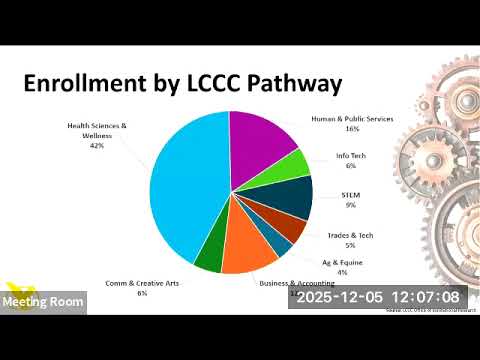
Schaefer said LCCC has posted consecutive year-over-year enrollment increases and marked improved graduation rates. He told the council the college currently offers two baccalaureate programs—applied management and health-care administration—and that it is exploring additional applied bachelor's degrees and pathways such as an alternate route to CPA credentials. "We want the college become a place people want to be," he said, framing the rebrand as part of a broader effort to grow the student population and post-completion success.
The president said market research found a steep "cliff of knowledge": outside Laramie and Albany counties, awareness of LCCC drops sharply and the name "Laramie County Community College" can produce confusion in neighboring states. That lack of recognition, he argued, can close doors when prospective students or families in a broader region make choices about where to enroll.
Schaefer proposed a geographic recruitment target—a 350-mile radius that includes much of Wyoming and adjacent portions of Colorado, Nebraska, South Dakota, Montana, Utah and Idaho—and said the board believes a name change could provide more immediate and durable returns than the alternative of investing the same funds in short-term scholarship or personnel spending.
Council members questioned the accreditor landscape for three-year bachelor programs and the estimated cost of a rebrand. Schafer said regional accrediting agencies are working on policy for three-year degrees and that a brand change could cost on the order of $1,000,000 (presented as the college's estimate), which he argued could produce longer-term enrollment benefits compared with recurring operating expenditures.
Why it matters: The college's proposal links institutional marketing to wider city and county priorities—student housing, downtown vibrancy and workforce pipelines. If the college successfully expands its market, Cheyenne officials may see greater demand for rental housing, internships and locally based employment pathways. Schafer asked city leaders to consider how municipal regulations, housing supply and amenities affect the college's ability to recruit and retain students.
What the college emphasized: Schafer repeatedly tied the rebrand pitch to concrete program growth and student supports. He described an Express Transfer Agreement with the university to improve transfer rates, an "Accelerate" dual-enrollment program that can deliver one year of tuition-free education to participants who enroll at LCCC, and continued expansion in trades, IT and health-care programs.
Council response and next steps: Council members raised cost and identity concerns and sought specifics about implementation and partnerships. Schafer suggested immediate, lower-cost collaborations—intern placement, applied learning experiences, and joint planning on housing and downtown amenities—while the college explores branding options. He offered to appear before appropriations to discuss capital construction and financial impacts.
The work session ended with council and college leaders agreeing to continue the conversation about coordinating housing, transit and internship pathways to support the college's recruiting goals.