Get Full Government Meeting Transcripts, Videos, & Alerts Forever!
Get email alerts on the Utilities Water topic
No spam. Unsubscribe anytime.
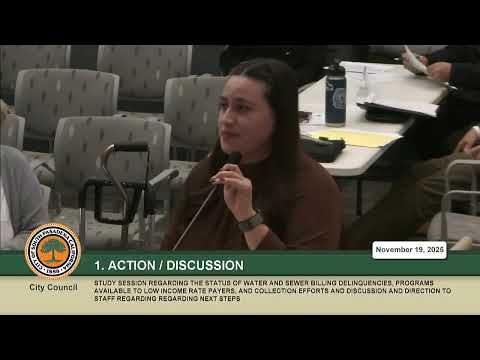
South Pasadena Council directs staff to pursue collections, outreach after water and sewer delinquencies top $1.7 million
Summary
City staff told the council the utility enterprise has more than $1.7 million in past due water and sewer charges and recommended a phased collection strategy that would prioritize large commercial accounts, expand outreach to enroll eligible low‑income customers, and consider selling long‑inactive debt to collectors.
Alma Medina, assistant to the city manager, told the council at a Nov. 19 study session that the water and sewer enterprise currently shows roughly $1.7 million in delinquent accounts — up from $1.6 million when the report was prepared — made up of both active and inactive accounts across single‑family, multifamily, commercial and private‑fire accounts. “Tonight's study session will be a water and sewer fund overview in relation to our current billing delinquencies,” Medina said, explaining the constraints of Proposition 218 on rate setting, the city's existing low‑income 40% water‑rate reduction program and the availability of payment plans.
Staff said most of the largest dollar balances are concentrated in a small number of commercial accounts, and that long‑outstanding “5+ year” balances largely stem from the city’s 2019 transition from in‑house billing to a muni‑billing vendor. Medina told the council inactive accounts—customers who have left the city—are difficult to collect and will likely require write‑offs or sales to debt collectors. She noted the city previously suspended shutoffs and late fees during the COVID emergency and identified reinstating those procedures — in compliance with SB 998 — as an option to restore predictable enterprise cash flow.
Council members pressed staff for context and additional data. “What percentage of our water revenue does this dollar amount represent?” asked Council member Omari; staff said the delinquency total is a little above 10% of roughly $13 million in annual water revenue and agreed to return with the exact customer counts and a detailed year‑by‑year delinquency breakdown. Council members also asked whether multifamily arrears are landlord or tenant responsibilities (staff: it depends on metering and lease terms) and whether the city or muni‑billing vendor had been sending repeated notices (staff: will check and include vendor activity in the report back).
On policy, staff and council discussed a multi‑part approach: 1) immediate customer outreach and notice to inform customers of outstanding balances and available payment plans and income‑based assistance; 2) marketing to increase enrollment in the low‑income reduction program (current utilization is “a few percentage points”); 3) a phased reinstatement of shutoffs beginning with commercial accounts and phasing in residential shutoffs with strong notification; 4) pursuit of inactive balances via collections or partial write‑offs; and 5) consideration of placing long‑delinquent balances on property tax rolls after legal review. Council members signaled support for sending delinquency notices and enhancing outreach, and asked staff to return with an implementation plan and an ordinance draft to ensure shutoffs comply with SB 998. One council member suggested a clear deadline — staff and council discussed January 31 as a target date for initial “bring current” notices.
The council did not adopt an ordinance at the meeting; instead it gave direction to staff to develop the outreach materials, an implementation timeline, an analysis of historic write‑off rates and options for collections and property assessment, and to return with a detailed plan at a subsequent meeting. Medina and the finance team said they will include a phased timeline for reinstating shutoffs, vendor performance information from the muni‑billing contractor, and a proposal for marketing and enrollment in the low‑income assistance program.
Next steps: staff will prepare materials for the council’s December meeting that include the outreach plan, the SB 998–compliant shutoff ordinance language, a proposal for how to treat inactive accounts (collections vs. write‑off), and the requested granular breakdown by customer type and years delinquent.