Get Full Government Meeting Transcripts, Videos, & Alerts Forever!
Get email alerts on the Land Use Rezoning topic
No spam. Unsubscribe anytime.
Mount Pleasant workshop moves toward dissolving long‑standing PRD, staff to draft reduced‑Civic rezoning
Summary
After hours of public comment and presentations, the City and Planning commissions signaled consensus to revisit a 2024 proposal to terminate a decades‑old Planned Residential Development (PRD) for five parcels southwest of Crawford and Broomfield and asked staff to prepare amended rezoning options that would reduce Civic‑zoned acreage and add mixed residential/commercial zoning.
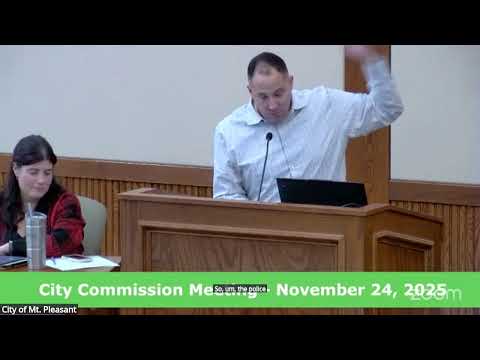
The Mount Pleasant City Commission and Planning Commission held a joint work session Nov. 24 to consider alternatives for the Planned Residential Development (PRD) that covers five parcels southwest of Crawford and Broomfield, and directed staff to prepare revised rezoning options that would shrink the Civic Zone portion and reclassify other acreage for residential or mixed use.
The session opened with multiple residents urging different outcomes. "Mount Pleasant is landlocked," said Giselle Moffitt during public comment, arguing the city needs housing and warning that mixed‑use rezoning could increase traffic and bring tax‑exempt uses that would reduce the city's tax base. Property owner Edward Peters told the commissions he had bought the land in 1996 and offered a compromise: shrink the school's footprint, add commercial acreage at the corner and reduce civic‑designated acreage, an approach he said could restore taxable value while enabling a private school on a smaller parcel.
Consultants from Progressive Company told commissioners the central legal question for a rezoning is whether the city is comfortable allowing the ‘‘basket of uses’’ that a zone permits, not whether a particular developer's plan will be built. Suzanne Schultz explained that rezoning establishes allowable uses for the future and that a PRD (a planned unit development) historically gave discretionary, site‑by‑site review that has slowed proposals on these parcels.
Commissioners discussed four options presented by staff and the consultants: do nothing; revisit the previously executed PRD termination and rezoning petition as originally proposed; revise that agreement and the rezoning approach; or pursue a broader code change to how civic/institutional uses are treated. Several commissioners said the existing PRD has been ineffective and that switching to clear CD‑3/CD‑4 zone districts would provide more predictable standards for developers and staff.
Several members expressed willingness to accept an amended agreement that would reduce the civic designation by a limited amount. "If we reduce the Civic Zone acreage, and add the corner as CD‑4, that gives us more flexibility and tax base while accommodating a school on a smaller footprint," Edward Peters told the commissions. Staff and counsel said they would work with property owners to prepare one or two mapped alternatives showing parcel splits, acreage numbers and the resulting zoning designations.
The workshop produced no formal vote on rezoning; rather, staff said commissioners had coalesced around option 3 (revise the prior approach) and asked staff to return with mapped options and precise acreage allocations. Planning staff flagged a common timeline for rezoning actions — an introduction, public hearing(s), and separate votes by planning and city commissions — and said the city would aim to present clear parcel maps so public feedback can focus on defined options.
What happens next: staff will draft rezoning scenarios (including a proposal discussed in the meeting that trims roughly 5 acres from Civic zoning and proposes CD‑4 for the corner parcel), show parcel lines and acreage calculations, and return with a formal introduction and public hearing schedule. No binding change will occur until those formal votes are taken.
Quote highlights from the meeting included residents and the property owner: "What the city needs are primarily two things, more income from taxes and affordable housing," said public commenter Giselle Moffitt; property owner Edward Peters said the earlier plan would have generated "$17,500,000" in tax base years ago and offered to amend the application to free acreage for taxable development. The consultants stressed process and law: "Rezoning is not approving a particular development," Suzanne Schultz said.
The work session closed with commissioners asking staff to return mapped alternatives and ancillary analyses (traffic, parcel‑by‑parcel acreage, and potential tax implications) so the commissions can consider a formal rezoning and any associated amendment to the PRD termination agreement.
The workshop is expected to lead to an introduction of a revised rezoning package, followed by public hearings and separate planning commission and city commission votes.