Get Full Government Meeting Transcripts, Videos, & Alerts Forever!
Get email alerts on the Zoning topic
No spam. Unsubscribe anytime.
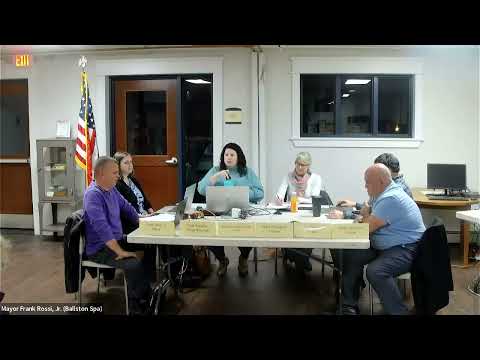
Ballston Spa trustees slow referral of zoning draft to give trustees time to review
Summary
Trustees chose not to immediately forward a revised zoning draft to planning and zoning, agreeing to circulate the consultant’s changes for trustee comment, with a possible board vote on Dec. 8 and public hearings expected in Jan–Feb 2026. Key unresolved items include minimum lot size, owner-occupancy rules and illuminated-sign standards.
Trustees in Ballston Spa agreed to delay forwarding a revised zoning draft to the planning board after a presentation from a board presenter who said trustees should have time to review the consultant’s changes. The board set a near-term review schedule and discussed several substantive open items, including lot-size minimums and use standards for residential zones.
The presenter, Carla, asked trustees to ‘‘let the board review it for the next, you know, week, provide Chris and I with any comments by the third, so that we can incorporate them into the draft,’’ and proposed that the board consider designating the village as lead agency and vote on the draft at the board’s Dec. 8 meeting. She said that schedule would allow the planning and zoning bodies the statutorily required 30 days for comment, and that public hearings could follow in January or February 2026.
Why it matters: the zoning law changes under discussion would redefine residential boundaries and standards across Ballston Spa, shaping allowable uses, subdivision potential and where sidewalks and infrastructure might be required. Trustees and residents said the precise choices in the draft could affect whether lots are subdividable and how two-family dwellings are regulated.
Trustee Baskin pressed the board to resolve a set of issues that members had agreed to at a prior special zoning meeting and said the board had ‘‘let another month slip away.’’ She listed outstanding items that she said should have been settled before the referral, including whether alternate planning-board appointments should be one- or two-year terms, whether two-family dwellings should have an owner-occupancy requirement, and whether minimum lot sizes are set at appropriate levels. ‘‘Since we are not doing the our job as far as I’m concerned, it’s gonna be up to the public to keep your eye on these changes,’’ Baskin said.
A resident who identified himself as Carlos of 89 Hyde disputed the claim that a 4,000-square-foot minimum would protect neighborhoods. He said he reviewed the assessment database and found that ‘‘one third of the properties in my area, between Hyde and Malta, have 100 feet or more of frontage,’’ meaning frontage-based protections could still allow subdivision under a 4,000-square-foot standard. He recommended a significantly larger minimum for suburban-style lots.
Other details the board identified as unresolved include standards that would allow illuminated signs in residential zones and where cluster development should be permitted. Trustees asked staff and the consultant to focus trustee comments on recent changes so the board could move the draft through the required review steps.
Next steps: trustees were asked to submit comments by Dec. 3 and the board discussed targeting a Dec. 8 vote to formally refer the draft or designate lead-agency status. If that timeline holds, planning-board comment and county review would run in January and public hearings could be scheduled in January or February 2026, with possible adoption in February, depending on the review cycle and hearing schedule.
The zoning draft conversation will resume at the board’s next meetings as trustees weigh edits and the public prepares to review the draft at the planning-board stage.