Get Full Government Meeting Transcripts, Videos, & Alerts Forever!
Get email alerts on the District Budget topic
No spam. Unsubscribe anytime.
Bassett Unified finance chief says 2025–26 shows $1.6M deficit; board told reserves will shrink without action
Summary
Chief Business Officer Susan Ibarra presented the district's first interim for 2025–26, reporting projected revenues of $44.9 million, expenditures that create approximately $1.6 million in deficit spending for 2025–26 and a projected decline in reserves in subsequent years absent corrective action.
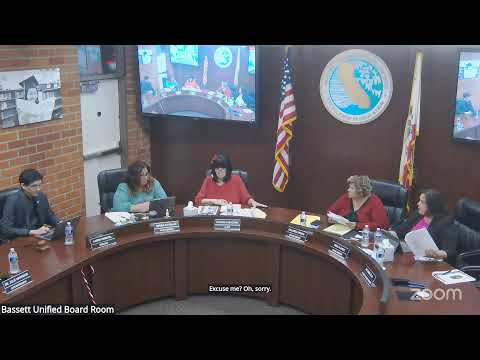
Susan Ibarra, Bassett Unified’s chief business officer, told the school board on Dec. 9 that the district’s first interim financial report for 2025–26 shows a projected $1,600,000 gap between revenues and expenditures for the coming year and continued downward pressure on reserves in out years if the board does not address ongoing deficit spending. "We are at a — and this is what we call deficit spending," Ibarra said during a slide presentation. She reported total unrestricted revenues of $44,900,000 for the current year and projected total expenditures of roughly $38.4 million plus contributions of about $8.1 million, resulting in the shortfall she described.
Ibarra explained the primary revenue drivers and risks: the district receives about 77% of its revenue through the Local Control Funding Formula (LCFF), which relies on state income, sales and property taxes. She said the state is currently projecting an $18 billion deficit and has signaled a longer‑term structural gap that could reach $35 billion annually starting in 2027–28 — numbers Ibarra used to illustrate the uncertainty around future COLA (cost‑of‑living) increases. "Proposition 98 guarantees base funding," she said, "but COLA increases are not guaranteed, and that matters for our out‑year planning."
Ibarra walked the board through enrollment and attendance figures the district used in its projections: enrollment recorded as 2,691 students and current attendance rate at about 94.89%, translating to roughly 2,553.36 ADA for funding purposes; she noted the district may elect to use a three‑year average ADA which can provide a higher funding base for 2025–26. She also spelled out several reserve constraints and set‑asides: non‑spendable funds, required reserve percentages, a board‑approved 7% designation, and litigation‑related set‑asides. After those items, Ibarra estimated roughly $11.7 million would be available from the $21.0 million projected ending fund balance for 2025–26.
Board members pressed staff on assumptions including the role of Prop. 98, how much lottery revenue supports schools and whether districts can unilaterally adopt COLA increases without state action. Ibarra said lottery revenue provides "very little" relative to the general fund and that any district decision to increase local pay scales without state COLA would have to be funded locally.
Ibarra outlined next steps in the budget cycle: the district will begin its budget work in January, attend a January 22 budget workshop, present the second interim in March and finalize budget adoption after the governor releases his proposed budget in May and the district updates projections leading to June adoption. She recommended aligning expenditures to projected funding levels and monitoring state economic signals.
The presentation concluded with a reminder that while the district currently projects a positive ending fund balance, ongoing deficit spending will reduce reserves over time unless the board and staff identify revenue increases or expenditure reductions. The board will next revisit the budget at the second interim in March 2026.