
Addison SD 4 superintendent urges board to consider health, life-safety bond to address $40–$50M facilities backlog
Get AI-powered insights, summaries, and transcripts
Subscribe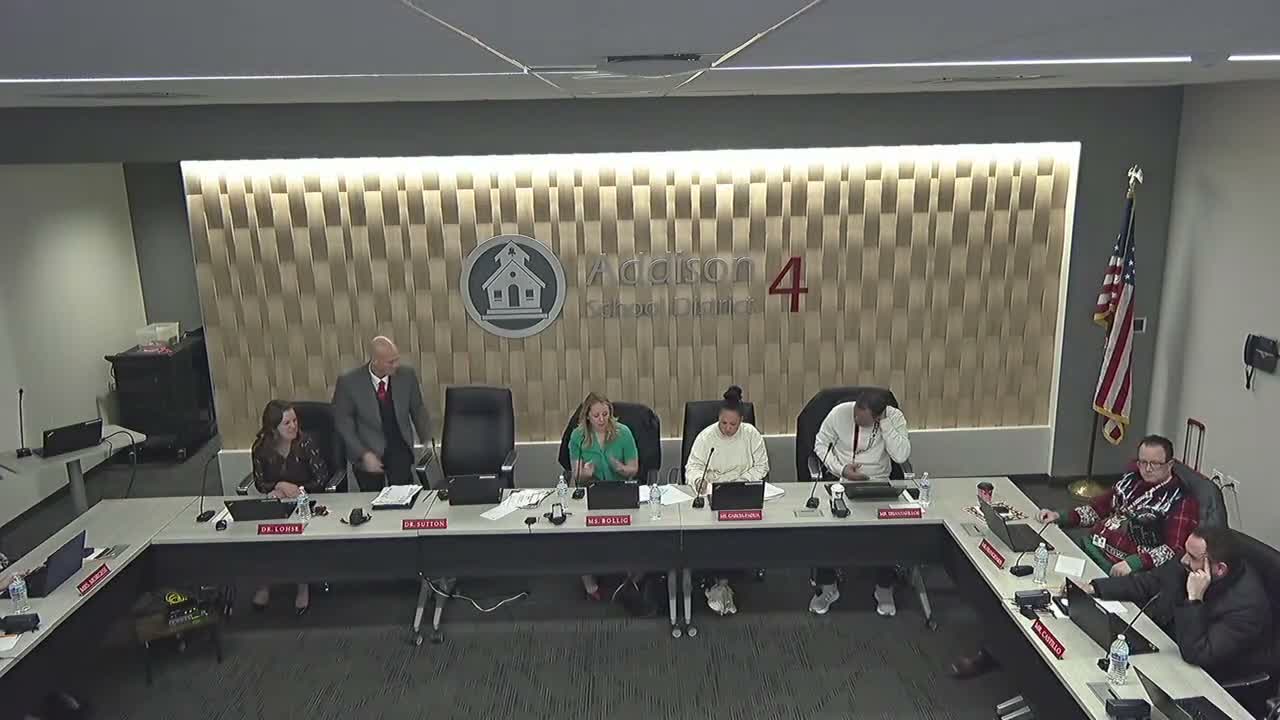
Summary
Superintendent Dr. Nick Sutton told the board Dec. 17 that rising property values and low tax rates have left Addison SD 4 drawing construction money from reserves and urged consideration of health, life-safety bonds to address an estimated $40–$50 million backlog for roofs, HVAC and other critical systems.
Superintendent Dr. Nick Sutton told the Addison SD 4 Board of Education on Dec. 17 that the district can no longer rely solely on reserve funds to pay for necessary construction and should begin formally considering health, life-safety bonds.
Sutton said total property values in the community rose from about $1.4 billion to about $1.8 billion in roughly three-and-a-half years. He said the district currently spends about $16,000 per pupil — ‘‘literally about 75% of what other nearby districts are spending’’ — while the state average is about $20,000 per pupil. At the same time, he said, Addison SD 4’s tax rate is roughly half that of neighboring districts.
‘‘We still need between $40 and $50 million of necessary construction that is stuff that relates to roofs, HVAC, purposeful stuff that relates to health life safety,’’ Sutton said, listing roofs, boilers and plumbing as examples. He said the district has paid for prior projects from reserve funds and that continued reliance on reserves is unsustainable.
Sutton described health, life-safety bonds as a targeted financing option that pays only for ‘‘necessary items’’ related to building safety — not for discretionary or ‘‘fancy’’ projects. He provided a rough taxpayer-impact example, saying the annual payment for a bond program could be roughly $2.5 million depending on the size of the issue and that, ‘‘for every $1 million bonded, [the impact] would be about 50 cents for a $300,000 home’’ on a property-tax bill, as a broad illustrative figure.
Board members asked clarifying questions. When asked whether Addison SD 4 currently carries debt, Sutton answered directly: ‘‘Addison 4 has no current bonds, no current debt and never has.’’ Board members discussed typical bond terms; a 10-year term aligned with the district’s 10-year life-safety planning horizon was cited as typical.
On timing, Sutton said he planned to put the topic on the board agenda for discussion in January and February, with the possibility of formal board action to move forward as soon as spring 2026. He said staff would invite a bond-sales partner (named in the meeting as PMA) to present options at an upcoming meeting and requested board members review questions and data needs ahead of January.
Why it matters: The bond discussion touches both district infrastructure and local property-tax implications. Trustees must weigh accelerating necessary repairs against voters’ appetite for a referendum and the district’s historically low tax rate.
What comes next: The board will discuss health, life-safety bonds at upcoming meetings (January and potentially February) and may invite PMA to present detailed financing scenarios. No referendum or formal bond authorization was taken at the Dec. 17 meeting.