Superior Court warns 20–24% cuts would halt essential dockets, judge says
Loading...
Summary
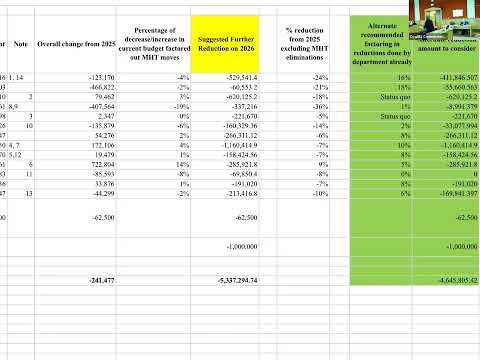
Superior Court Judge Michael Evans told commissioners that proposed 20–24% cuts (roughly $1.5 million from a $7–7.5M court budget) would force elimination of court commissioners and mandated services, potentially prompting constitutional challenges.
COWLITZ COUNTY — Michael Evans, assistant presiding judge for the Superior Court, told commissioners during Tuesday’s budget workshop that proposed cuts to the court’s 2026 budget are so steep they would undermine the court’s ability to carry out constitutionally required duties.
Evans said Superior Court’s operating budget is roughly $7 million to $7.5 million and that a reduction of about $1.5 million — a 20–24% cut in some scenarios presented by finance staff — would force the court to eliminate court commissioners and halt or curtail mandatory services such as guardians ad litem and appointed counsel in minor guardianship cases. He listed the dockets that would be disrupted: protection order hearings, child support and contempt matters, guardianship and probate calendars, involuntary treatment motions, eviction calendars and dependency matters.
"The proposed reduction of $1,500,000 is not a trimming of excess. It is the removal of essential sinew and muscle," Evans said, urging the board to weigh not only budget savings but also the "far greater cost of failing to do so." He warned that if such deep cuts are adopted, the judiciary "may be required to invoke its constitutional authority to secure adequate funding."
Finance staff earlier noted the Superior Court line shown in Budget Boss and an OFM-recommended figure used for modeling: the OFM-recommended 2026 number cited by finance was $2,647,707 for the line items under discussion. Commissioners and finance clarified that some services and positions are mandated, and that the board sets the court’s overall budget but cannot unilaterally direct which judicial functions survive without raising separation-of-powers concerns.
The judge’s testimony prompted multiple commissioners to ask staff and legal to consider alternatives and to factor constitutional constraints into any reduction decisions. No formal reductions were adopted at the workshop; commissioners directed staff to continue exploring options and to provide materials in time for a hearing scheduled next week.