
State Land Board outlines updates to agriculture leasing, stewardship and RFP process
Get AI-powered insights, summaries, and transcripts
Subscribe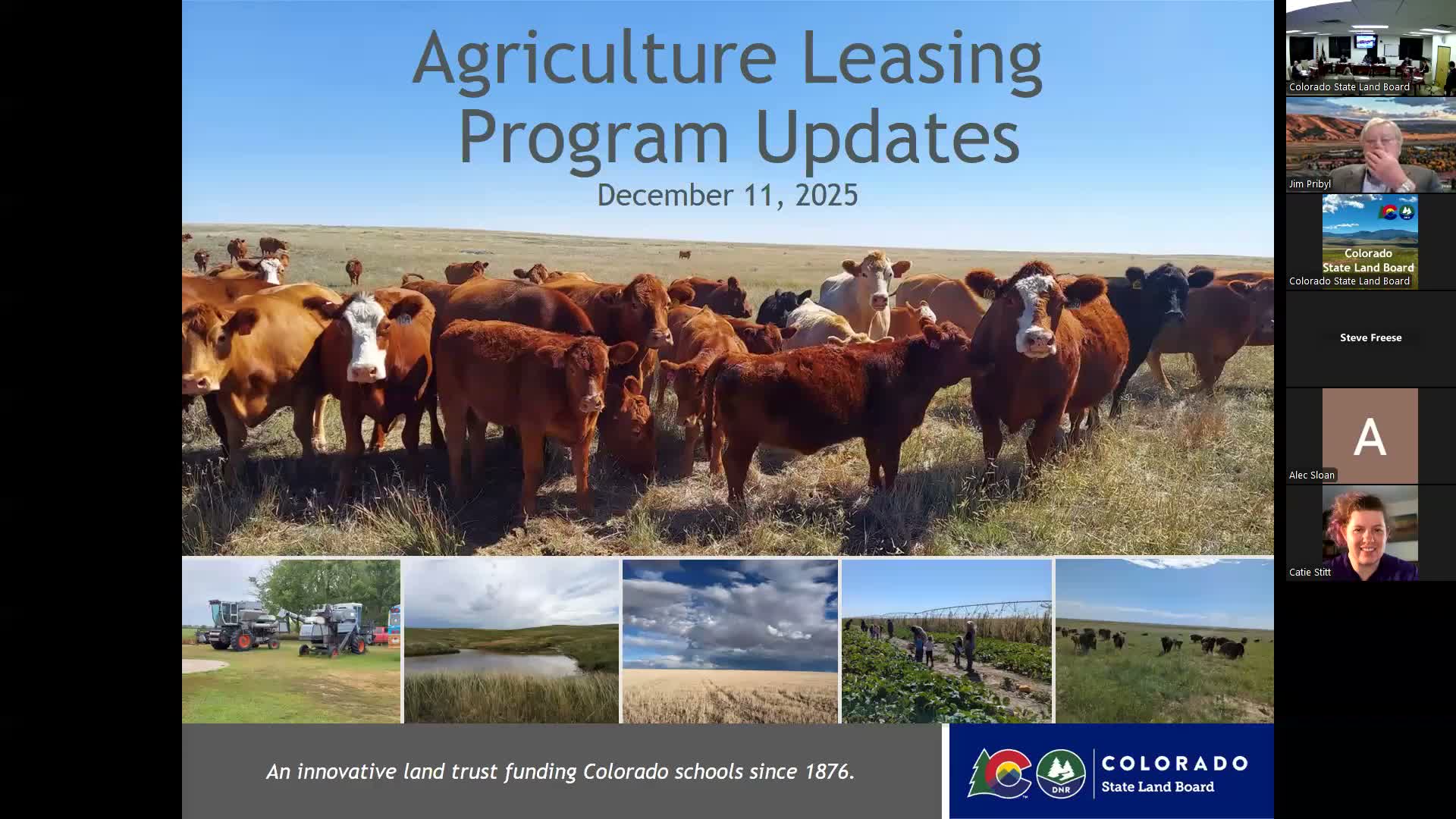
Summary
Staff presented a sweeping review of the agriculture leasing program, highlighting that about 96% of trust land is in agricultural use, $16.2 million in lease revenue last year, expanded stewardship work (inspections, cost-share funds, regenerative agriculture), and planned updates to forms, scoring and RFPs with a phased implementation and board engagement.
Rachel Turner, the State Land Board's field operations team lead, delivered an in-depth presentation on the agency's agriculture leasing program and proposed updates to stewardship and leasing procedures.
Turner said 96% of trust land is in some form of agricultural use and that the program administered roughly 1,900 leases last fiscal year, generating about $16.2 million in revenue. She reviewed the agency's leasing mechanisms'standard renewals under statutory "1-18" rights, sealed bids, requests for proposals (RFPs) for large ranch assets, and assignments'and described how stewardship is incorporated through inspections, cost-share funds and the regenerative agriculture program led by Jesse Price.
Staff highlighted specific stewardship tools and funding: a noxious weed fund (base budget $150,000), a land-and-water cost-share fund governed by statute 36-1-148 (annual statutory cap of $75,000 noted), and a build operations budget used for smaller district projects. Turner said these tools support on-the-ground projects including wells, ponds, weed control, and recent investments such as virtual fencing.
Turner described ongoing updates to application and evaluation forms: staff aim to formalize extra credit for producers participating in programs like grassland carbon leases, add wildlife-friendly scoring, and lower barriers for new producers (for example, awarding points for qualified apprenticeships or mentor relationships). She also explained RFP strategy for complex assets (Chancellor Ranch, Chico Basin Ranch, Lowry, Williams Park) and said the team is preparing an RFP for Sherman Creek with public advertisement planned in January.
Commissioners and staff discussed remote sensing and AI as complements to on-the-ground inspections, engaging higher-education partners (CSU programs and graduate students) for research and GIS support, and legislative and strategic-plan timelines. Director Rosmarino said staff will provide frequent updates during the upcoming legislative session and the board scheduled a strategic-plan workshop in February, an information item in April, and a decision item in May.
Turner requested continued board support for three priorities: additional resource specialists for districts, funding for targeted projects and improvements, and advocacy for agriculture programs. She said staff will continue to iterate forms and engage line-of-business working groups over the next several months.
Next steps: staff will run phased updates to forms and guidelines, hold work-group sessions starting in January, and return to the board with progress reports and decision items tied to the strategic planning timeline.