
ULCT explains tax‑increment and homeownership zones to help cities spur more starter homes
Get AI-powered insights, summaries, and transcripts
Subscribe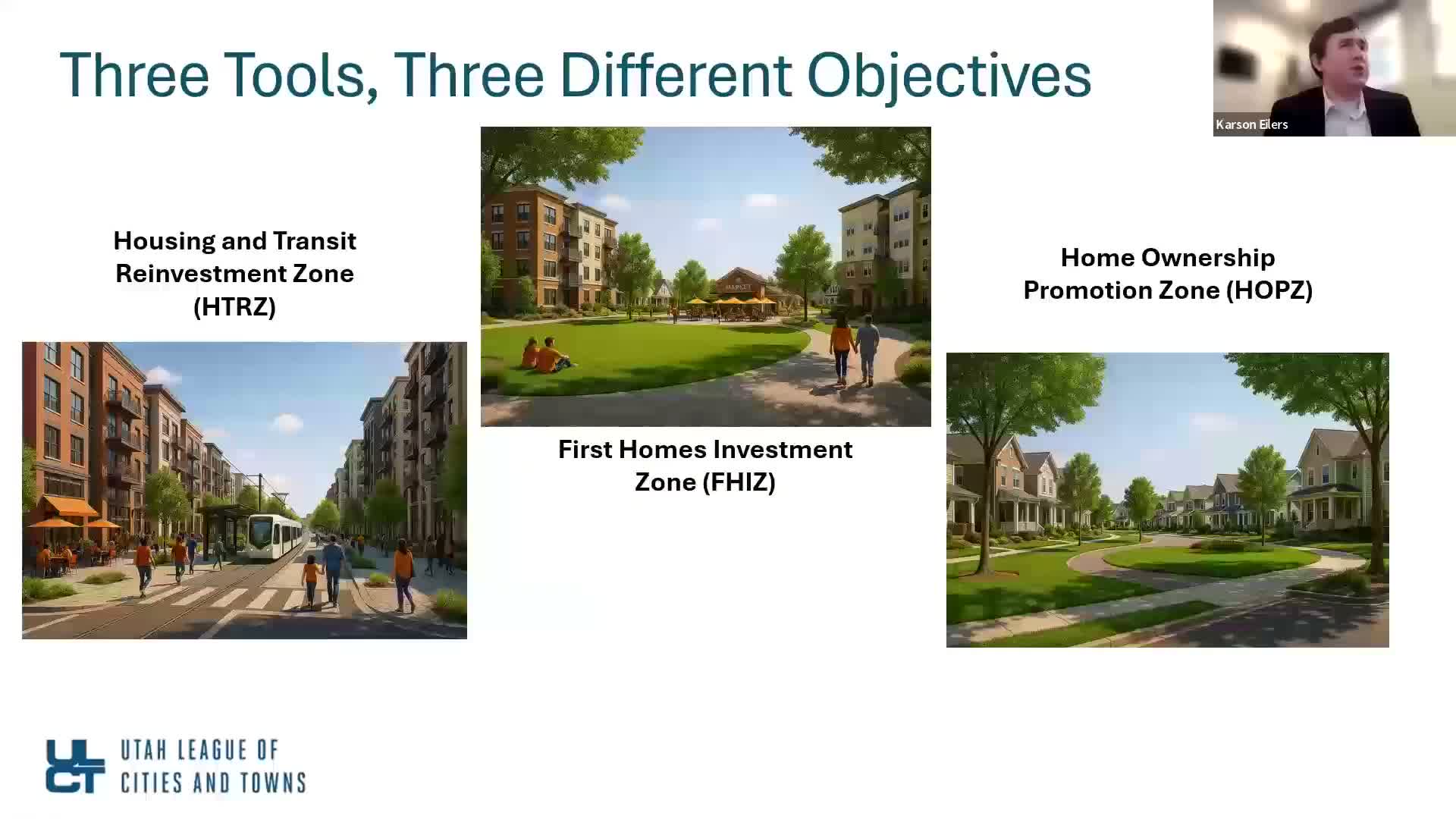
Summary
ULCT policy staff outlined state incentive tools — housing and transit reinvestment zones (HTRZ), First Home Investment Zones (FIS), and Homeownership Promotion Zones (HOPS) — designed to pair tax‑increment revenue and local planning to support more affordable housing and homeownership.
Carson Eilers, identified in the session as the ULCT policy director, said state policymakers emphasize increasing housing supply and that the League has promoted incentive‑based tools because the legislature limited mandatory local inclusionary zoning.
Carson described three main incentive tools: the Housing and Transit Reinvestment Zone (HTRZ) for higher intensity, transit‑centered development; the First Home Investment Zone (FIS), described as a center‑development tool with income targets roughly in the 80–120% AMI range; and the Homeownership Promotion Zone (HOPS), a smaller option limited to under 10 contiguous acres with at least six units per acre, a minimum affordability restriction (at least five years), and specific density calculations to qualify for tax‑increment assistance.
He noted tax‑increment financing for residential areas generates less tax increment than commercial development due to residential property exemptions, and that HTRZ projects can require sign‑off from other taxing entities (school districts, counties) though project boards often include those entities and have supported many proposed projects. Carson said these tools are optional for cities, initiated by local governments, and recommended cities review the ULCT toolkit and examples (Mill Creek, Park City) to match tools to local assets and goals.
Carson also summarized moderate income housing plan requirements (cities >5,000 in urbanized areas must include a plan and select from 29 possible strategies) and noted pending legislation could change that framework.