Get Full Government Meeting Transcripts, Videos, & Alerts Forever!
Get email alerts on the Tif Finances topic
No spam. Unsubscribe anytime.
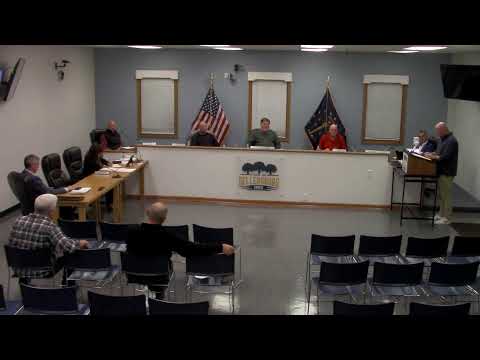
Sellersburg redevelopment commission presents 2024 TIF results, files 2026 spending plan
Summary
At its Dec. 1 meeting, the Town of Sellersburg Redevelopment Commission presented its annual TIF report showing 2024 revenues of $1,690,813.97, reviewed 2025 year‑to‑date activity, and filed a 2026 spending plan that contemplates up to $10.23 million in potential capital and professional expenditures.
The Town of Sellersburg Redevelopment Commission on Dec. 1 delivered its required annual presentation on tax‑increment financing activity, reporting strong revenue growth in 2024 and filing a spending plan for 2026 with the state.
Gary Lake, who delivered the presentation, said the commission’s 2024 total revenues were $1,690,813.97 and that the commission entered 2025 with cash available to pursue projects. “2024 total revenues were $1,690,813.97, which put this commission into a stratosphere that it had not previously been in,” Lake said.
The presentation explained TIF mechanics and the Sellersburg Economic Development Area’s history: the allocation area was established in 2008, confirmed in 2009, amended in 2018 and expanded in 2020. Lake said the district collects on increment from improvements to real property only, not personal property, and that the allocation area contained 192 parcels as of the 2024 annual report submission to the Department of Local Government Finance (DLGF).
The commission reported two active debt obligations tied to the allocation area: a 2022 Camp Run bond with $3,900,000 principal (final payment Jan. 15, 2037) and a 2025 lease‑rental revenue bond with $8,645,000 principal (final payment Jan. 15, 2039). Lake said the commission’s 2024 TIF fund expenses were $482,040.46, which included improvements such as pickleball courts and Camp Run access work, and that the TIF fund carried a cash balance into 2025.
“Again, showing increasing revenue and capacity,” Lake said of 2025 activity, reporting pay‑2025 year‑to‑date revenue at $964,814.06 and year‑to‑date expenses, prior to the meeting, at $718,004.98.
The commission also filed its 2026 spending plan with the DLGF on Dec. 1. Lake summarized contemplated capital expenditures and professional services under the plan: $50,000 for campground solar lighting, $150,000 for the Apple Leaf traffic signal, $8,400,000 for Camp Run sewer improvements (to be funded from bond proceeds), $250,000 for US‑31 area sound barriers, $100,000 for other infrastructure projects and $270,000 for professional services — a maximum package of about $10,231,630 that the presenter said would be revisited and amended as projects advance.
Lake framed the plan as a living document that must align with the commission’s economic development plan and IC 36‑7‑25‑8 reporting requirements. “This presentation is required to provide general information of the activities of the redevelopment commission, including information on the budget expenditures for the tax increment revenue generated by the TIF,” Lake said, citing the statute.
Project updates included work on Camp Run lighting and the Ivy Tech interceptor. The Wheatley Group reported the Programmatic Categorical Exclusion (PCE) environmental document for the Camp Run lighting project had been submitted to INDOT for review; once INDOT approves, the commission will be able to set a bid schedule. Commissioners were also told the Ivy Tech interceptor notice to proceed has been issued and contractor Mac has started construction; easements were secured and ARPA funds are being used for some materials.
The commission did not vote on the spending plan itself at the meeting; Lake said the figures represent contemplated maximums and that any changes would come back to the commission for formal approval and, where required, to the DLGF as an amended spending plan.