
Public commenters accuse San Bernardino County Board of Education of repeated Brown Act violations as trustees adopt agenda
Get AI-powered insights, summaries, and transcripts
Subscribe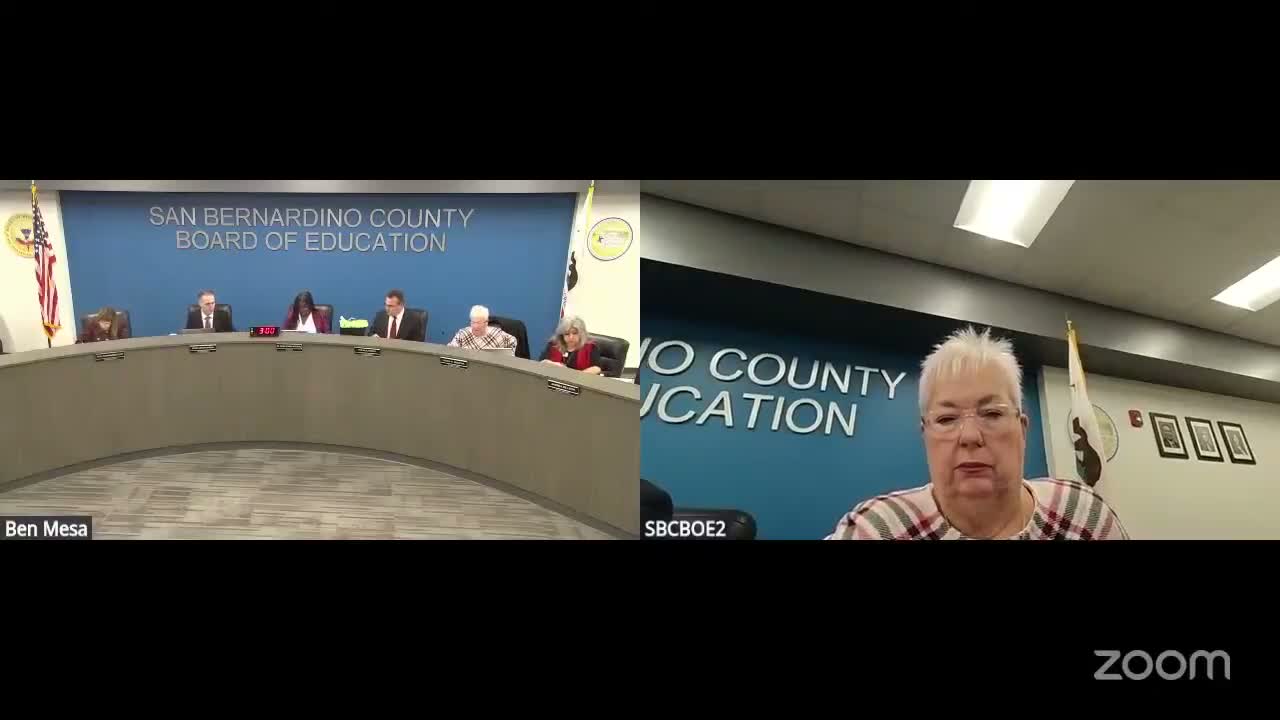
Summary
Multiple public speakers urged the board not to adopt the meeting agenda, alleging repeated Brown Act violations and conflicts of interest tied to board members’ outside organizations; the board adopted the agenda after brief discussion and one trustee signaled concerns about closed-session specificity.
Several members of the public used the agenda-adoption portion of the Dec. 15 San Bernardino County Board of Education meeting to press the trustees on alleged Brown Act violations and demands for greater disclosure.
Antoinette opened public comment saying the board had failed to place Brown Act complaints on previous agendas and cited California Government Code section 54959: “Any member of a legislative body who knowingly violates the Brown Act is guilty of a misdemeanor,” she said. Other speakers, including a commenter who identified themself as DK, accused board leadership of ignoring repeated transparency problems and of enabling misconduct by not agendizing complaints. Mary Davis of the Public Education Oversight Project said she had filed a successful “cure and correct” action in another county and urged the district attorney to investigate local omissions.
Those public remarks came before trustees moved to adopt the meeting agenda. Trustee discussion included an expression of concern from one member about the lack of specificity in the closed-session description; that trustee said they would not support adoption if the closed session items remained vague. After a motion and a second, the board voted to adopt the agenda. The chair called the motion carried despite public objections.
Why it matters: The Brown Act requires public bodies to list certain items and complaints on their agendas so the public and other members of the legislative body can participate. Speakers told the board they view repeated omissions as an ongoing transparency problem that could require outside review. The board’s action to adopt the agenda despite those objections sets the stage for follow-up public scrutiny and, as at least one commenter suggested, possible external inquiry.
What happens next: Several speakers asked the board to place Brown Act complaints and conflict-of-interest clarifications on a future agenda and to consider outside investigation if local enforcement does not act. Board members signaled they will discuss minute-taking policy and agenda specificity at future meetings.
Representative quotes: “Brown Act complaints and requests for correction are required to be clearly listed and publicly addressed,” Antoinette said during public comment. “That’s why I protest the adoption of the agenda,” Mary Davis said, urging the district attorney to investigate if the board continues to withhold complaints.
Ending: The board proceeded to adopt the agenda; trustees and staff told the meeting they expect to return to several of the transparency and minute-correction questions at a later date.