Get Full Government Meeting Transcripts, Videos, & Alerts Forever!
Get email alerts on the Nerf Grant And Ceqa topic
No spam. Unsubscribe anytime.
IRPA authorizes $9 million CDFW grant application for NERF planning; staff outlines CEQA/NEPA scope and outreach plan
Summary
The IRPA board approved a resolution authorizing submission of an application for about $9 million from the California Department of Fish and Wildlife to support design and environmental compliance for the New Eel–Russian Facility (NERF). Sonoma Water and consultants presented a CEQA/NEPA scope, estimated costs and plans for public and tribal outreach.
The Eel Russian Project Authority on Dec. 11 authorized its executive director to submit an application and execute a grant agreement with the California Department of Fish and Wildlife for approximately $9 million to fund planning and design for the proposed New Eel–Russian Facility (NERF), and separately authorized staff to seek additional state and federal grants.
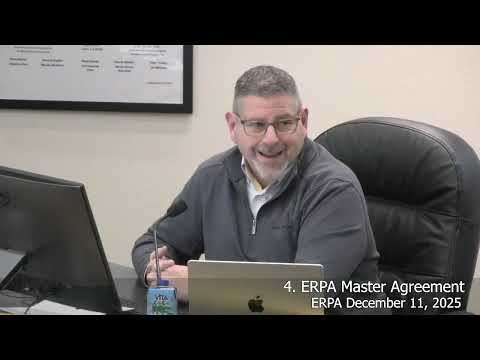
Executive Director David Manning told the board CDFW Director Chuck Bonham had committed $18 million to the two‑basin partnership, split as roughly $9 million for the new facility and $9 million for Eel River restoration. Manning said the CDFW pledge led to the board action to authorize a formal application and to allow the executive director to accept and implement an award if granted.
The board then heard an informational update on the environmental review and permitting scope from Jessica Martini Lam, Environmental Resources Division Manager with Sonoma Water, and Jim O’Toole of Environmental Science Associates (ESA). Jessica said IRPA will act as lead agency under the California Environmental Quality Act and that compliance will be required to obtain state permits such as a State Water Resources Control Board 401 water‑quality certification and a California Department of Fish and Wildlife 1602 streambed alteration agreement. "CEQA is basically a disclosure law," Jessica said, describing the statute’s role in identifying project impacts and mitigation measures.
Manning and presenters outlined preliminary cost estimates and tasks: about $5,000,000 for continued and later design phases, roughly $3,000,000 for environmental compliance and permitting tasks, and earlier design work funded by a U.S. Bureau of Reclamation grant of $2,000,000 (with a $1,000,000 local match). Consultants told the board the CEQA/NEPA scope-of-work estimate for the consulting team was $2,130,000 to prepare environmental analyses, permitting support and public engagement.
ESA said the environmental review would analyze construction, operation and maintenance of the NERF facility (including fish screens, pumps and conveyance) with technical analyses of hydrology, biological resources, cultural resources, recreation and agricultural effects; the team will coordinate closely with the State Water Board and PG&E’s parallel decommissioning process. Jim O’Toole said the technical team includes Applied River Science for river impacts, David’s Engineering for agricultural effects and a subconsultant to prepare cultural‑resources studies.
Directors asked about timing given the announced departure of CDFW Director Bonham; Manning said the director has treated the pledge as a high priority and staff are working with the director’s office to advance the award before his departure, but acknowledged some application and grant‑execution steps will extend beyond the director’s tenure.
Jessica described multiple public input opportunities: a notice of preparation and scoping meetings, public meetings during review of a draft environmental impact report, and AB 52 tribal consultation initiated by IRPA outreach to tribes. Board members asked that meetings be accessible across the project area (Ukiah, Potter Valley and Alexander Valley were discussed) and pressed for agricultural stakeholder outreach tailored to local users.
The board voted by voice vote with no opposition to adopt the resolution authorizing the grant application and to authorize the executive director to pursue further grants.
Next steps: staff will file the CDFW application, undertake CEQA/NEPA scoping and public outreach, and return to the board with drafts and timelines as the environmental review advances.