
Senate education committee hears case for small, community-led rural schools during White River Valley visit
Get AI-powered insights, summaries, and transcripts
Subscribe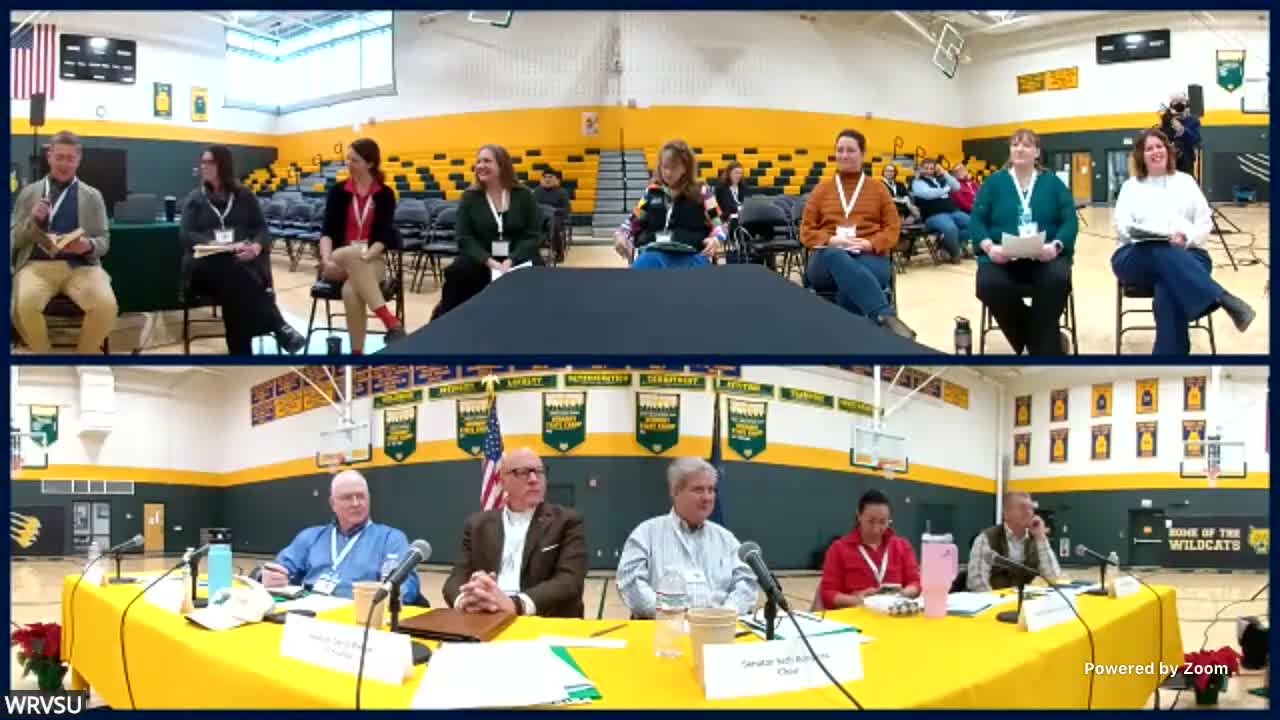
Summary
At White River Valley High School, educators and principals told the Senate Education Committee that small, community-rooted schools and the community-school model produce stronger relationships, wraparound services and improved student outcomes, while urging careful, locally led merger processes.
The Senate Education Committee visited White River Valley High School on a field hearing to hear from students, teachers and principals about the strengths and challenges of small, rural schools. Committee chair Seth Bongart opened the session and said the delegation had toured campuses and convened panels so senators could "see what rural schools look like" and hear directly from those "very close to the ground."
Educators stressed that close relationships and local partnerships are central to students' success. "School is the heart of community," said Brian Eric, a librarian at Newton School, summarizing a staff survey he compiled. Mary Shell, community school coordinator for White River Valley Supervisory Union, said the community-school model intentionally uses local resources and partners "to remove barriers to student and family engagement," naming UVM interns and local mental-health and health providers as collaborators.
Principals described how shared roles and voluntary mergers expanded course offerings and services without raising per-pupil spending. "We were able to provide occupational therapy, physical therapy and dental services at school so students never have to travel an hour to access those services," said Wendy Stefan, principal of Rochester–Stockbridge Unified District. Wendy Benven, principal at Rogers and Stafford Elementary, said the district reported per-pupil spending near the figure she cited for the current year (stated in materials as $12,470.12) while expanding arts, PE and literacy interventions after a merger.
Teachers and interventionists gave concrete examples of classroom practice: Donna Gallant, a lead interventionist, described individualized reading and spelling assessments and flexible groupings; Kylie Edwards, a special educator, said keeping students in-district for alternative education preserves belonging and continuity of services. Several speakers said the community-school approach helped reduce chronic absenteeism and support students with complex needs.
Panelists likewise described robust after-school and summer programming, embedded tutoring and meal services designed to support students from low-income households. "We run a seven-week summer program with transportation and embedded tutoring so we don't lose ground over the summer," a principal said.
Committee members thanked the panelists and said the materials and conversations will inform their policy discussions. The session paused for a planned musical performance and a 20-minute break.
Why it matters: Vermont policymakers are weighing system changes — from how supervisory unions are configured to how state funding and accountability measures are applied. Local educators who testified urged voluntary, well-timed mergers that preserve community voice and highlighted partnerships and service delivery that rural districts rely on to meet students' academic and nonacademic needs.
The committee said it will continue hearings and analysis before proposing statutory changes.