
Nampa staff brief council on comprehensive-plan rules, zoning limits and disclosure obligations
Get AI-powered insights, summaries, and transcripts
Subscribe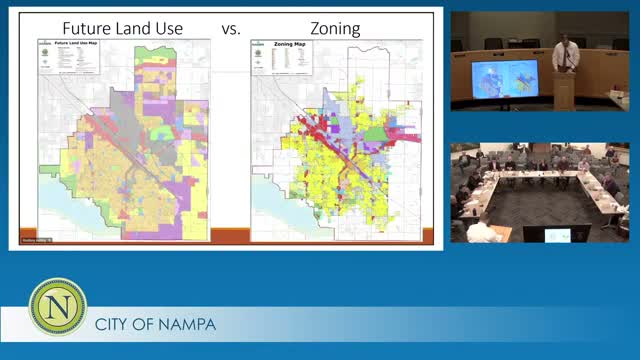
Summary
City staff and legal counsel told the council that the future land use map and comprehensive plan (required by state code and the local land use planning act) guide zoning decisions, explained limits on spot zoning and ex parte communications, and recommended a January workshop for deeper training.
Presenter (Speaker 6) told the council that the city’s comprehensive plan and future land use map are statutory documents that set the long-term vision for land use and must be updated regularly. “The comprehensive plan is required by state code and local land use planning act,” Presenter (Speaker 6) said, adding that the plan typically looks 20–25 years ahead and that zoning must align with the future land use map.
Staff emphasized the difference between the plan’s broader designations and site-level zoning. Presenter (Speaker 6) demonstrated how one comp‑plan designation (RMU, residential mixed-use) can translate to several zoning districts (RMH, RS6 and BC) and said the city allows a limited, one‑parcel “stretch” of a future land use designation when reviewing annexations or rezones.
Legal Counsel (Speaker 7) advised council members about ex parte contacts and conflicts of interest in quasi‑judicial matters. “Anything that happens outside the 4 corners of that meeting…you’ve got to double it into the meeting,” counsel said, instructing members to disclose private communications and to seek counsel when unsure about potential economic interests under Idaho law.
Council members raised the recurring issue of enclave parcels and whether ownership transfers can trigger annexation; legal staff said state statute constrains any ordinance that would make annexation automatic upon sale and that compelled annexation typically requires specific statutory procedures or parcel‑by‑parcel actions.
Several council members requested a focused workshop to unpack the authority to attach conditions to comprehensive‑plan amendments, the use of development agreements, and how to hold future plats to the spirit of master‑plan approvals. Staff scheduled or confirmed a January training workshop to provide more in‑depth guidance and examples.
The presentation concluded with staff reiterating that most of the guidance is available on the city website, that pre‑application meetings are required for annexations and rezonings, and that development agreements and design‑review processes are the primary tools to protect council intent should master plans be implemented over many years.