
East Side Union HSD Receives Qualified First Interim; Board Adopts Fiscal Solvency Resolution
Get AI-powered insights, summaries, and transcripts
Subscribe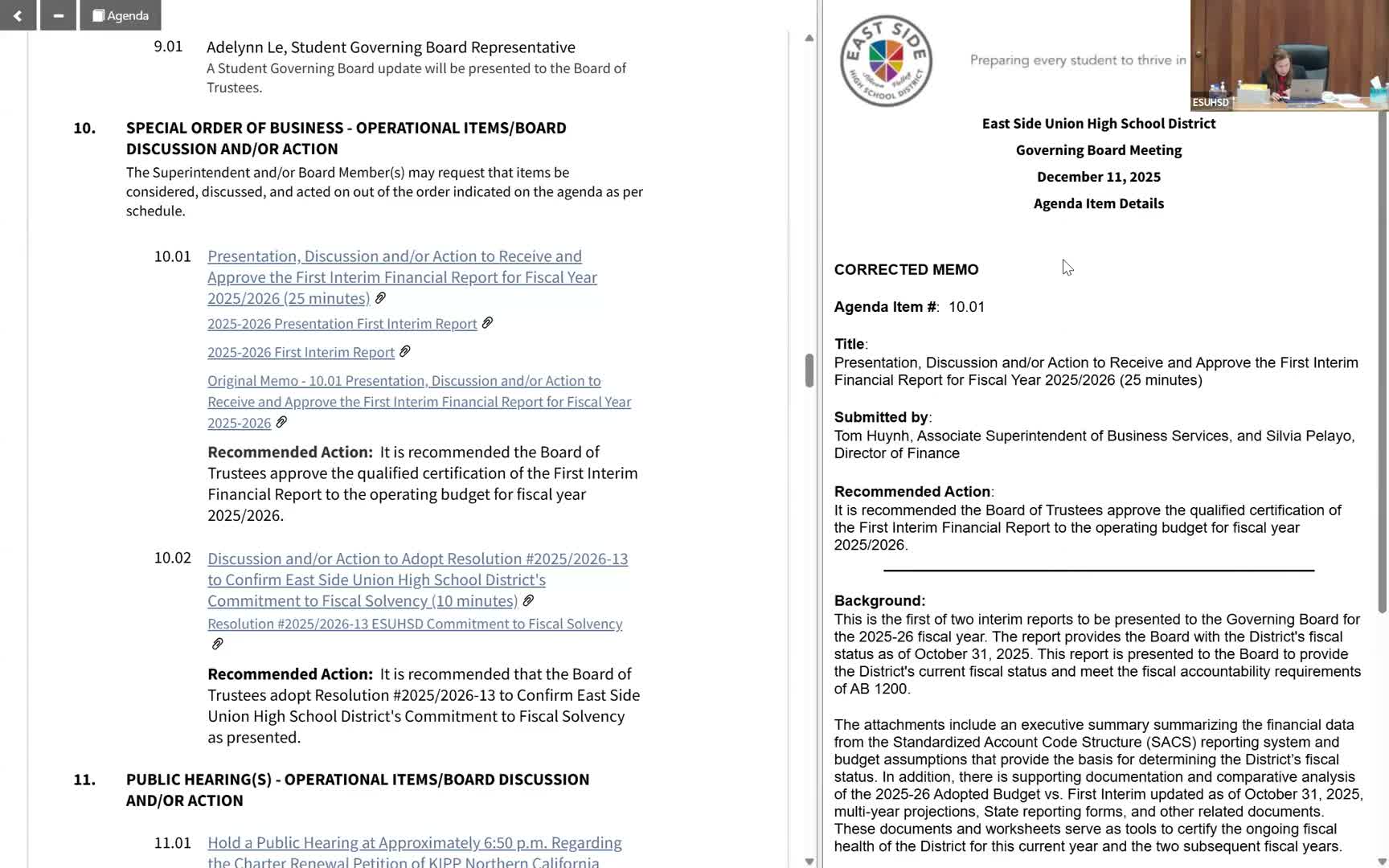
Summary
The board received a qualified first interim financial report for FY25–26 that projects a $30.6 million multi‑year deficit and adopted a revised fiscal solvency resolution directing roughly $16 million in cuts next year to restore unrestricted reserves.
The East Side Union High School District board received a qualified first interim financial report on Thursday and voted unanimously to adopt a revised fiscal solvency resolution designed to shore up reserves.
Associate Superintendent Tom Wen told trustees the district’s first interim — which covers fiscal data through Oct. 31 — shows the district will meet immediate obligations in 2025–26 but faces structural deficits in subsequent years. "We are presenting to you tonight a qualified budget," Wen said, noting the district projects a $30,600,000 cumulative deficit in the multi‑year projection and that a 3% unrestricted reserve target is about $12.5 million.
The report laid out the assumptions driving the projection: a boost of roughly $6.5 million tied to the district’s UPP (a funding metric tied to average daily attendance and other factors), continuing annual enrollment declines of about 400 students, parcel tax revenue projected near $6 million, and modest salary/COLA assumptions. Wen said increased county special‑education indirect costs created an unanticipated $4.6 million charge that worsened the projection.
Why it matters: the district must show sufficient unrestricted reserves to meet its legal obligations; without changes the report showed shortfalls in 2026–27 and 2027–28. Wen said adopting the fiscal solvency resolution would shift the projection to a positive certification by showing a combination of expense reductions and structural changes.
Board action and next steps: trustees voted unanimously to receive the interim and then to adopt the revised fiscal solvency resolution (Resolution 2025‑26, as described in staff materials). The resolution identifies categories for reductions — contracts and operations, administration, classified and certificated personnel reductions — and illustrates about $16 million of reductions for the upcoming year that staff say would restore the district’s unrestricted reserves above the 3% threshold. Wen and staff said they will bring detailed implementation steps to upcoming budget advisory and board meetings and will update trustees after the governor’s January budget release.
Trustee questions focused on which expense categories would be affected and the process for stakeholder input. Wen emphasized the district is preparing both immediate reductions and longer‑term plans and said recommendations would be discussed at upcoming budget committee meetings. "If we adopt the resolution as you recommended it, will we be positive rather than qualified?" one trustee asked. Wen replied, "We will." The board requested an updated briefing after the governor’s Jan. 10 budget announcement.
The board also scheduled related committee reviews and asked staff to circulate clear timelines and proposed cuts before formal budget adoption in June.