Santa Ana USD pushes LCAP engagement as parents press for school-level results and special-education supports
Loading...
Summary
At a Dec. 2025 town hall, district educational leaders described the Local Control Accountability Plan process and invited community input; parents pressed for school-by-school budget/outcome data, expanded scratch-cooking at elementary schools, and stronger special-education monitoring.
Santa Ana Unified School District officials used a Dec. 2025 town hall to walk families through LCAP priorities and to gather community feedback on how the district should allocate supplemental and concentration LCFF dollars.
"We get to make our own plan," said Dr. Wolk of educational services, describing the LCAP as a state-mandated three-year plan that must align the budget to community priorities. He explained the LCAP’s key buckets — student outcomes, engagement (including parent involvement), and conditions of learning (facilities and materials) — and described ThoughtExchange and other tools the district will use to collect and prioritize community input.
Wolk highlighted recent progress on state dashboard metrics, saying the district improved on five of seven areas this year, with gains in English learner progress, college-and-career readiness and math moving some measures from orange to yellow or green.
During facilitated small-group reports and an audience Q&A, parents and table representatives raised specific, actionable requests: more professional development to address bullying; consistent "scratch cooking" meal practices at elementary and middle schools consistent with high school models; upgrades to play fields, playgrounds and restroom cleanliness; no wait lists for after-school programs; and districtwide distribution of technology (laptops).
"We have seen all of the hard work... but we would like a streamline of services or what is happening in high schools through nutrition services to also be available to our elementary school students," a table representative said when reporting results from a small-group charting exercise.
Parents also urged the district to publish school-by-school allocations and outcomes. "We would like to receive data school by school, school specific data of the budget allocation and student achievement," Margarita Gonzales told the panel. District staff committed to providing disaggregated expenditure and outcome analyses: an internal review will break down expenditures by school site, department and more detailed categories and report findings at second interim.
Special education was a recurring focus. Staff described ongoing work to analyze patterns in how students qualify for special education services so the district can design targeted interventions, and explained their monitoring process uses CALPADS and other tools to compare services delivered to services required. The district acknowledged restricted special-education funding is inadequate to meet needs and that unrestricted general fund contributions are required to close gaps.
To gather more detailed feedback the district will use spring work groups composed of DLAC, CAC, APAC and school-site councils, plus continued ThoughtExchange ranking. Officials said they will "close the loop" by reporting what the district implemented in response to community requests.
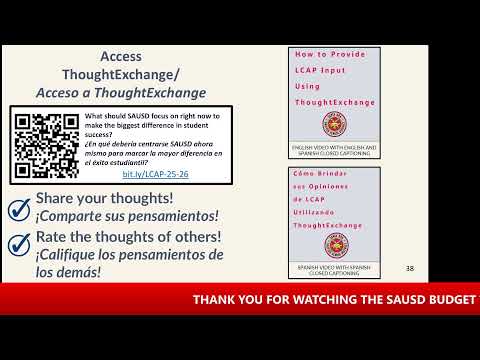
The town hall ended with facilitators asking participants to submit or rank ideas in ThoughtExchange (QR provided) and with staff remaining after the session to answer remaining questions.
What happens next: the district will incorporate feedback into the LCAP development timeline, run the internal audit and provide the second-interim enrollment/special-education budget deep-dive planned for early 2026.