
House subcommittee hears bipartisan package of nine bills to speed geothermal permitting
Get AI-powered insights, summaries, and transcripts
Sign Up Free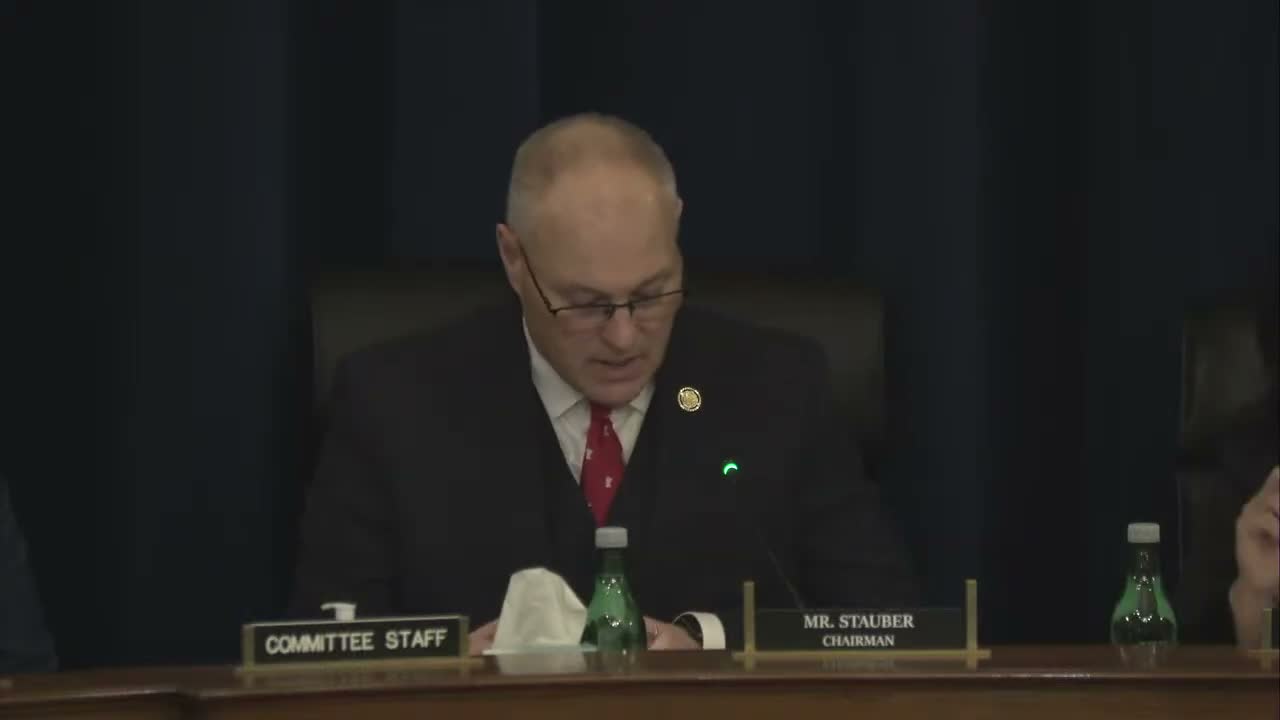
Summary
A House Natural Resources subcommittee heard bipartisan testimony supporting nine bills intended to streamline geothermal leasing and permitting on federal lands, with BLM and industry witnesses endorsing deadlines, categorical exclusions for limited exploration, an ombudsman and a 'gold book' of best practices; no votes were taken.
The House Natural Resources Subcommittee on Energy and Minerals Resources held a hearing on a nine‑bill package intended to accelerate geothermal energy development on federal lands.
Chair Stauber opened the hearing saying the United States needs new baseload power as demand rises and that cumbersome leasing and permitting on federal lands has prolonged project timelines. He cited a U.S. Geological Survey estimate that the Great Basin alone hosts about 135 gigawatts of geothermal potential and said federal geothermal projects may require up to six separate NEPA reviews and can take “up to 10 years.” The chair framed the bills — including the Geothermal Energy Opportunity Act (GEO Act, HR 301), the Clean Act (HR 1687) and others — as measures to provide predictability and reduce duplicative delays.
Representative Ansari, the subcommittee’s ranking member, said geothermal delivers 24/7 carbon‑free power and expressed bipartisan support for many bills, emphasizing the need for a permitting system that can scale next‑generation geothermal. Sponsors described individual bills: HR 1687 would require annual lease sales in states with federal geothermal resources; HR 5576 would expand categorical exclusions to cover small exploration wells (under 8 acres restored within three years); HR 301 would require agencies to act on completed applications within 60 days; and HR 5631 would create a geothermal ombudsman and permitting task force to coordinate BLM field offices.
John Rabe, Nevada State Director for the Bureau of Land Management, testified that the BLM manages geothermal leasing on hundreds of millions of surface and sub‑surface acres and that the agency supports the goals of several bills (he named HR 301, HR 1077, HR 5587, HR 1687, HR 5576, HR 398, HR 5638, HR 5617 and HR 5631). Rabe told members the BLM currently manages 569 geothermal leases covering roughly 1.2 million acres and that geothermal production on public lands generated over $33 million in fiscal year 2025. He said BLM has adopted numerous categorical exclusions and estimated 60–90 days to develop a new congressionally directed categorical exclusion.
Industry witnesses emphasized that permitting — not technology — is the primary barrier to scaling geothermal. Tim Latimer, chief executive officer of Fervo Energy, described the company’s Cape Station project in Utah (permitted for up to 2 GW, initially 100 MW coming online next year and 400 MW later) and said Fervo has reduced drilling time and cost per foot sharply since 2022. Paul Thompson of Ormat Technologies described how royalty calculations have been applied in practice and supported the Geothermal Royalty Reform Act (HR 5638) to make royalty treatment plant‑by‑plant.
Conservation groups urged that reforms preserve environmental safeguards. Dr. Carrie Rohrermeyer of The Nature Conservancy (Nevada) said geothermal can be deployed responsibly but recommended following the mitigation hierarchy, protecting cultural resources and ensuring adequate agency staffing and science to support timely review.
Committee members questioned witnesses about how state permitting compares with federal review, the role of categorical exclusions and ‘‘extraordinary circumstances’’ that would require fuller review, staff turnover and measurable success metrics (for example, reduced permit lead times, number of permitted megawatts and increased consistency among BLM field offices). BLM officials said temporary staff reassignments and a formalized ombudsman could help, and that many small exploration activities would be suited to categorical exclusion if extraordinary circumstances are absent.
No formal votes were taken. The hearing record was held open for written questions (members were instructed to submit questions by 5 p.m. on Friday, December 19) and the subcommittee adjourned. The bills will proceed through the committee process where the subcommittee and full committee may consider amendments and additional analysis.