Residents, activists press Akron City Council on police accountability, Waste Management deal and saving Firestone clock tower
Loading...
Summary
At a packed Akron City Council meeting, a long public-comment period centered on police accountability and calls for a community benefits agreement with Waste Management; speakers also urged preservation of the Firestone Plant 1 clock tower and opposed an Amazon warehouse. Council took no formal action on most public requests but listened while passing routine business.
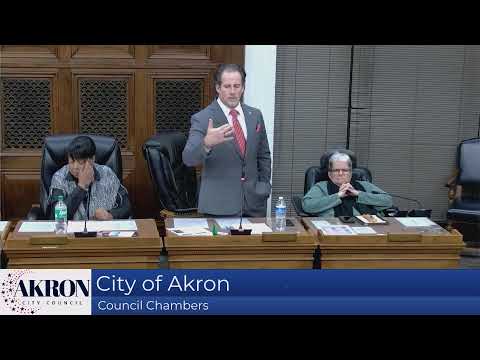
A sustained public-comment period at an Akron City Council meeting Tuesday night saw residents and community organizers press elected officials on police accountability, a proposed Waste Management facility and efforts to preserve the clock tower at the former Firestone Plant 1.
Melania Mohammed told the council a federal judge "threw out the case" involving the police shooting of Mohammed Issifane and said, "and I quote, the officers were justified in killing Mohammed because he committed a misdemeanor," accusing the department of condoning "murderous behavior." Her remarks included an account of delayed aid at the scene; she was cut off when her three-minute time expired. (Public speakers' comments reflect their statements to council.)
Pastor Mark Tibbs, speaking for Akron Community Action Network (Akron CAN), urged council to seek a community benefits agreement (CBA) with Waste Management for a proposed facility on Archwood Avenue, saying Akron residents should be at the negotiating table rather than left out of host-community arrangements. "Put residents ahead of corporate profits and insist that Waste Management... act to protect residents," Tibbs said.
Other speakers included Nathaniel Green, who recommended city funding for an external review by the National Organization of Black Law Enforcement Executives to examine promotion, hiring and field-training issues beyond use-of-force concerns; Donnie Brooks, who criticized council responsiveness and limits on public comment; and David Goran, who asked that an Amazon warehouse item be removed from the consent agenda and raised traffic and safety concerns near a community facility.
Dana Noel urged the city and administration to review the "true cost" of saving the front building and clock tower at Firestone Plant 1, arguing that preserving only the clock face would destroy the structure's contextual value. Several speakers from neighborhoods near Firestone Park asked council to explore county and land-bank partnerships to preserve the landmark.
Lillian Barnes, participating remotely, invoked the First Amendment and Article I, Section 11 of the Ohio Constitution and called for an independent records review under the Ohio Public Records Act (RC 149.43) into communications and relationships between council and the Fraternal Order of Police, and warned that any changes to the public-comment rules must be viewpoint-neutral.
Council members did not take formal votes on the specific demands raised in public comment. The meeting's business agenda proceeded; the council approved the meeting minutes and later passed the consent agenda and a series of ordinances and resolutions. Many speakers requested follow-up from the administration and suggested concrete next steps, such as contracting outside experts and pursuing community benefit protections in future agreements with private firms.