
Homestead council adopts revised trolley master plan with new routes and stops
Get AI-powered insights, summaries, and transcripts
Subscribe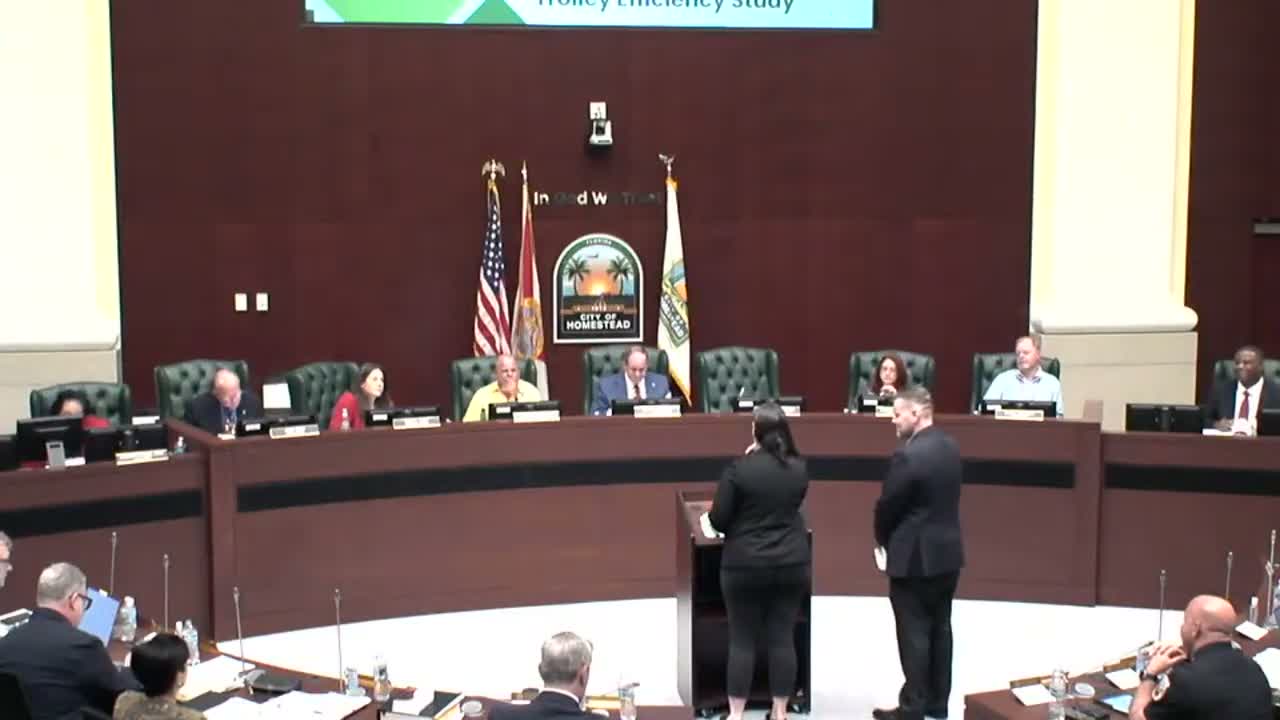
Summary
Council approved a trolley master plan updating Western, Central and Eastern routes, adding stops to connect residential areas to schools, retail and BRT service; staff expects Miami‑Dade County approval and potential 2026 implementation, pending grant funding and vehicle procurement.
Council adopted final trolley route alignments and stop locations on Dec. 17 after a staff presentation and public workshops earlier in 2025. Consultant Corinne Beam of Kimley‑Horn reviewed the study timeline, public engagement and the proposed Western, Central and Eastern routings designed to increase access to schools, shopping, health care and regional BRT connections. "Following our public workshops... we finalized those route alignments, incorporating public feedback as well as feedback from city staff and other stakeholders," the consultant said.
Staff and council discussed operational details: the system currently runs one vehicle per route (one bus per route), and the city has applied for DOT grants to double the fleet; automatic passenger counters are set to be installed to improve ridership data and planning. Funding and PTP (People's Transportation Plan) rules were also discussed; staff cautioned the council about PTP constraints and explained that initial operations may be grant‑funded as a pilot with the potential to reduce frequency rather than terminate service if ridership is below expectations.
Council approved the plan as presented and requested that future counter‑rotating (opposite‑direction) route alternatives be included in the submittal to Miami‑Dade County to avoid resubmittal later. Staff said the next steps are county approval, design and construction of stops, and an anticipated service start in 2026 subject to vehicle availability.