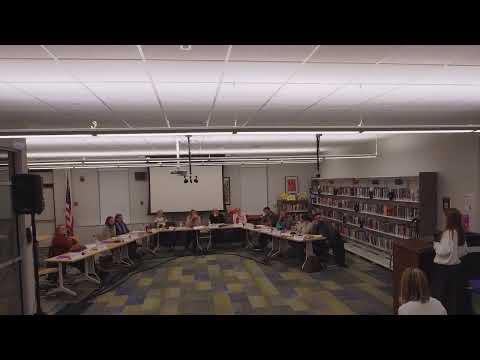
RSU 5 board advances phone-policy first read after students, teachers press concerns about Yonder pouches
Loading...
Summary
After sustained public comment from students and teachers opposing a bell-to-bell phone ban and the purchase of Yonder pouches, the RSU 5 board brought a new cell-phone policy (JICJ) forward for first read and directed administrators to draft implementation procedures; the board agreed implementation will be staged for 07/01/2026.
The RSU 5 Board of Directors on Dec. 10 advanced a new district policy on student cell phones and personal electronic devices to a formal first read, after students, teachers and staff urged caution about a proposed bell-to-bell ban and the district purchase of Yonder pouch systems.
Students who spoke at the meeting argued the pouches would create safety and equity problems and divert money from pressing staffing and mental-health needs. "We need guidance, not restrictions that treat us as if we aren't capable of learning these skills," said Emily Kelsch, a Freeport High School sophomore. Hazel Gullett, another student leader, told the board, "Yonder pouches are a safety issue," citing concerns about contacting family or emergency services during a school day.
Teachers also warned of instructional harm and accommodation challenges. "Purchasing Yonder bags is hard to justify" in a year with potential teaching-position cuts, said Melissa Lucci, a Freeport High School science teacher, who noted that phone-based tools are used for fieldwork and some learning accommodations.
On the draft policy, the policy committee and board members emphasized that the document is intended to establish principles and education rather than micromanage enforcement techniques. The draft sets the policy's scope to student-owned devices while on school grounds during the school day, provides medical and health-based exceptions tied to individual health plans, and lists potential consequences for misuse while directing building administrators to develop the detailed procedures for enforcement.
Board members agreed to remove a clause that would have broadly covered devices "with or without internet connectivity" after concerns it could inadvertently ban non-networked devices (for example, a digital camera or simple pedometer). The committee also decided to add clarity that camera or voice recording in privacy areas such as bathrooms and locker rooms is prohibited, and that the policy's misuse provisions may apply "at all times, including outside the school day," in places where privacy is expected.
Superintendent Gray and staff will return revised language for a second read. The policy committee proposed an implementation timeline that emphasizes education and preparation for staff, students and families, with a target effective date of July 1, 2026, to allow time for training and for administrators to craft workable procedures.
The board took the first‑read vote on the policy package (JICJ and EBBD temperature standards) with all members in favor and none opposed. Formal procedural details for how the district will administer exceptions, special-education accommodations, and classroom-level practices were left to the superintendent and building administrators.
What happens next: staff will refine the policy language and administrative procedures and present a second read to the board. The district also indicated it will consult special-education staff about how health orders and individual health plans should interact with policy exceptions.