Get Full Government Meeting Transcripts, Videos, & Alerts Forever!
Get email alerts on the Transportation 10 Year Plan topic
No spam. Unsubscribe anytime.
Georgia DOT lays out 10‑year transportation plan, highlights funding mix and technology push
Summary
The Georgia Department of Transportation presented a 10‑year plan that relies on a mix of state excise and transportation fees, federal apportionments and bond tools; GDOT outlined allocation ranges for construction, maintenance, bridges and safety and previewed connected‑vehicle deployments.
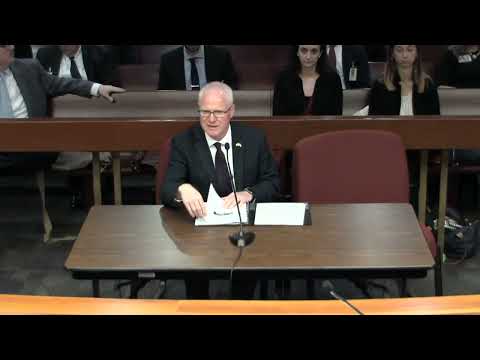
The Georgia Department of Transportation presented its 10‑year transportation plan to the joint House‑Senate Transportation Committee, outlining where money comes from, how it will be allocated and technology the agency plans to deploy.
Commissioner Russell, presenting the plan, said the funding picture combines state excise and transportation fees with federal apportionments and targeted bond and grant tools. "Between the excise and the state funding, that totals to be $2,188,000,000, of which about $2,540,000,000 comes to GDOT to be used for transportation purposes," he told the committee. On federal funding he said Georgia's apportionment is about $1.421 billion while the annual obligation authority in the current fiscal exercise is about $1.281 billion.
Why it matters: the plan sets broad priorities for new construction, system preservation and safety over the coming decade and identifies the near‑term pipeline of projects that state leaders and local officials will use to shape budgets and local planning.
GDOT outlined the share of dollars expected to go to major categories over the 10 years: construction and new‑highway capacity approximately 48–52 percent, maintenance roughly 22–27 percent, bridge repair and replacement about 8–11 percent, safety‑focused activities about 7–8 percent and administrative costs near 8 percent. "Every project we do has a safety benefit," Russell said, while noting the safety line‑item captures work that is safety‑focused in particular.
Russell described how state and federal rules shape what projects can be done and when. He walked through the project selection funnel—state strategic plans, MPO priorities and the State Transportation Improvement Program—and reminded members that most federal projects require a 20 percent non‑federal match and that federal funds are generally reimbursable: "we spend the money first and then we send the feds the bill, and they pay us back 80¢ on the dollar," he said.
The commissioner also pointed to near‑term construction activity: an 18‑month "shotgun map" of projects represents about $2.74 billion of construction, with roughly $3.26 billion in construction value when combining FY2020 and FY2021. GDOT reported nearly 1,451 professional services contracts last year (design, geotechnical, right‑of‑way work) worth about $489 million in services to get projects ready.
Committee members pressed GDOT on several topics. On roundabouts, Russell said federal funding can fully cover certain roundabout projects and argued they reduce severe collisions by lowering speeds and eliminating T‑bone crash opportunities. On right‑of‑way costs in Metro Atlanta, Russell said GDOT is using pre‑acquisition for larger mobility projects to reduce future cost escalation when federal approvals permit it. On managed lanes and tolling, he explained toll revenue is the mechanism that typically allows private financing to be repaid over long terms.
GDOT also emphasized technology and freight efficiency. The agency plans early deployments of vehicle‑to‑infrastructure communications at intersections. "We will, over the next 2 or 3 years, deploy 1,000 technology and 1,000 traffic signals that will communicate to your vehicle," Russell said, arguing the system will improve safety and fuel efficiency for freight vehicles by enabling smoother flows through signals.
The department highlighted studies used to justify investment: a Carl Vinson Institute analysis shows meaningful local economic returns from transportation spending; Russell summarized the study's multiplier findings when questioned by members.
Next steps: the committee received the presentation and was told the formal adoption of the 10‑year plan will be taken up in a follow‑up meeting and before session ends. Members were invited to follow up with GDOT staff and district engineers for district‑level details.