Get Full Government Meeting Transcripts, Videos, & Alerts Forever!
Get email alerts on the Charter Reform topic
No spam. Unsubscribe anytime.
Danvers holds public hearings on multiple charter revisions; debate centers on town meeting size, manager residency and recall rules
Summary
Select Board public hearings on the Town Meeting Act, Town Manager Act and recall bylaw prompted robust public comment: residents disagreed about shrinking town meeting seats, required manager residency (board agreed to require Commonwealth residency), and recall language that would exclude removal simply for votes except conflict‑of‑interest cases.
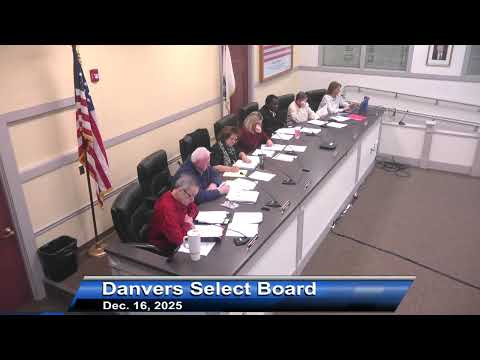
The Select Board used its Dec. 16 meeting to hold three public hearings on proposed charter and bylaw revisions: the Town Meeting Act, Town Manager Act and the recall bylaw. Each hearing drew residents, town meeting members and committee representatives who urged changes or clarified the committee’s recommendations.
On the Town Meeting Act, a central point of debate was whether to reduce the number of town meeting members per precinct from 18 to 15. Committee members and some town meeting members argued 15 could improve deliberation and participation; others warned reduction could be perceived as limiting representation. Town records reviewed by participants showed attendance rates typically near 85 percent of the complement, and town staff noted the clerk determines seat counts after each census. The board voted to forward the warrant package to the Finance Committee with a favorable recommendation while leaving the question open to further input.
Discussion of the Town Manager Act focused on section 8, which previously removed a residency requirement. Several speakers urged the board to require the town manager reside within the Commonwealth of Massachusetts (instead of within the town), to ensure the manager remains subject to state laws and can meet in‑person expectations. The board agreed to revise the draft to require residency within the Commonwealth while noting that proximity and on‑site expectations can be clarified in the town manager’s role description.
The recall bylaw hearing produced lengthy discussion over wording that would exclude recall for votes on policy matters. The committee-recommended language would state that a vote of an elected official on a matter, other than in connection with a conflict‑of‑interest violation, shall not constitute valid grounds for recall; at the same time the draft notes the voters ultimately determine whether grounds are sufficient. Speakers emphasized balancing protection for officials who vote their conscience against the public’s right to recall for serious misconduct. The board accepted edits to reconcile sections so that votes alone (except conflict‑of‑interest cases) are not grounds for recall.
Each hearing generated requests for greater transparency (e.g., publishing committee term start/end dates online) and for procedural clarity about how warrant articles will be presented at the special town meeting. The board set dates for the special town meeting and for closing the warrant, and directed staff to provide warrant materials and legal review as part of the January packet ahead of the final public meeting.