Get Full Government Meeting Transcripts, Videos, & Alerts Forever!
Get email alerts on the Local Budget topic
No spam. Unsubscribe anytime.
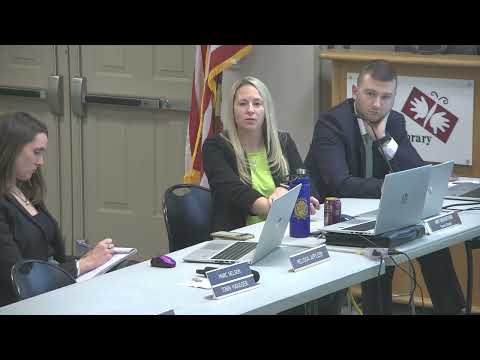
Simsbury Board of Finance approves budget guidance aiming to limit next tax increase
Summary
The Board of Finance approved budget guidance asking staff to model scenarios that hold a long-term tax-increase target near 2% while using reserves and a $1 million health-savings allocation to reduce near-term pressure; staff will return with detailed scenarios and assumptions.
The Simsbury Board of Finance voted unanimously to approve budget guidance that asks staff to model scenarios aimed at limiting the town's projected tax increase while managing capital and debt-service timing.Speaker 3 moved to approve the guidance and, after a second, "All in favor, please say aye," the chair said; the motion carried unanimously.
Why it matters: the guidance frames key decisions the town and the board of education must use while preparing FY27 budgets, including how to use reserves, how to apply one-time health savings and how to smooth a forecasted debt-service spike in the early 2030s.
The board reviewed detailed capital-financing modeling during the meeting. "For fiscal year 27, it's anticipated to be 9,000,064," Speaker 1 said when displaying the debt-service line, underscoring why members want to use reserves and timing to avoid a steep mill-rate increase. Members discussed a range of options: issuing debt if interest rates fall, or using cash and reserves if rates remain elevated.
Board members directed staff to assume conservative revenues for initial scenarios and to show multiple options for handling a large future capital project. Staff identified about $5,000,000 in unassigned reserves that could be used for capital-reserve planning and described a strategy that could accumulate roughly $10,000,000 by 2031 to offset future bonding.
The board also agreed to use up to approximately $1,000,000 in health-insurance savings this year as an offset to the operating budgets. Members discussed splitting that amount roughly 70/30 between the board of education and the town; under one staff scenario that allocation reduced modeled tax-increase outcomes (example: a modeled town operating increase near 3.78% and school increase near 3.31% that together move the projected overall tax increase nearer to the board's working target of roughly 2.3%).
On retirement and benefits policy, the board agreed to transition to fuller use of the OPEB trust; speakers noted the net operating impact for the current year would be modest. "This is sort of a no-brainer spent to save $20,000,000," Speaker 3 said in reference to the recommended OPEB approach as presented by the actuary, though staff clarified net near-term budget effects are in the low six figures.
Directives and next steps: staff (Amy and team) were asked to return with scenario modeling that shows alternatives for: (1) smoothing a potential debt-service spike tied to a large future capital project, (2) allocations of the $1,000,000 health-savings assumption and how different splits affect mill-rate projections, and (3) assumptions on vacancy rates and turnbacks. The board emphasized conservative revenue assumptions for initial modeling and asked for quarterly reports and clear documentation of CIP/CNR assumptions (project start/finish dates, escalation assumptions and where funds are nonlapsing).
The board approved the guidance as presented and said it would revisit the guidance if revenue or grand-list numbers change. The meeting concluded after approval of minutes with one editorial change and a motion to adjourn.
Direct quotes in the meeting: "For fiscal year 27, it's anticipated to be 9,000,064," Speaker 1 said while showing debt-service figures. When discussing the OPEB move, Speaker 3 said, "This is sort of a no-brainer spent to save $20,000,000." At the vote, the chair called, "All in favor, please say aye," and the motion carried unanimously.
The board asked staff to circulate the guidance document and follow up with modeling by January so the board and the town's elected bodies can consider revisions before final budget submissions.