
Simsbury leaders present preliminary FY2027 budget guidance, flag projected tax increase and $2M gap
Get AI-powered insights, summaries, and transcripts
Sign Up Free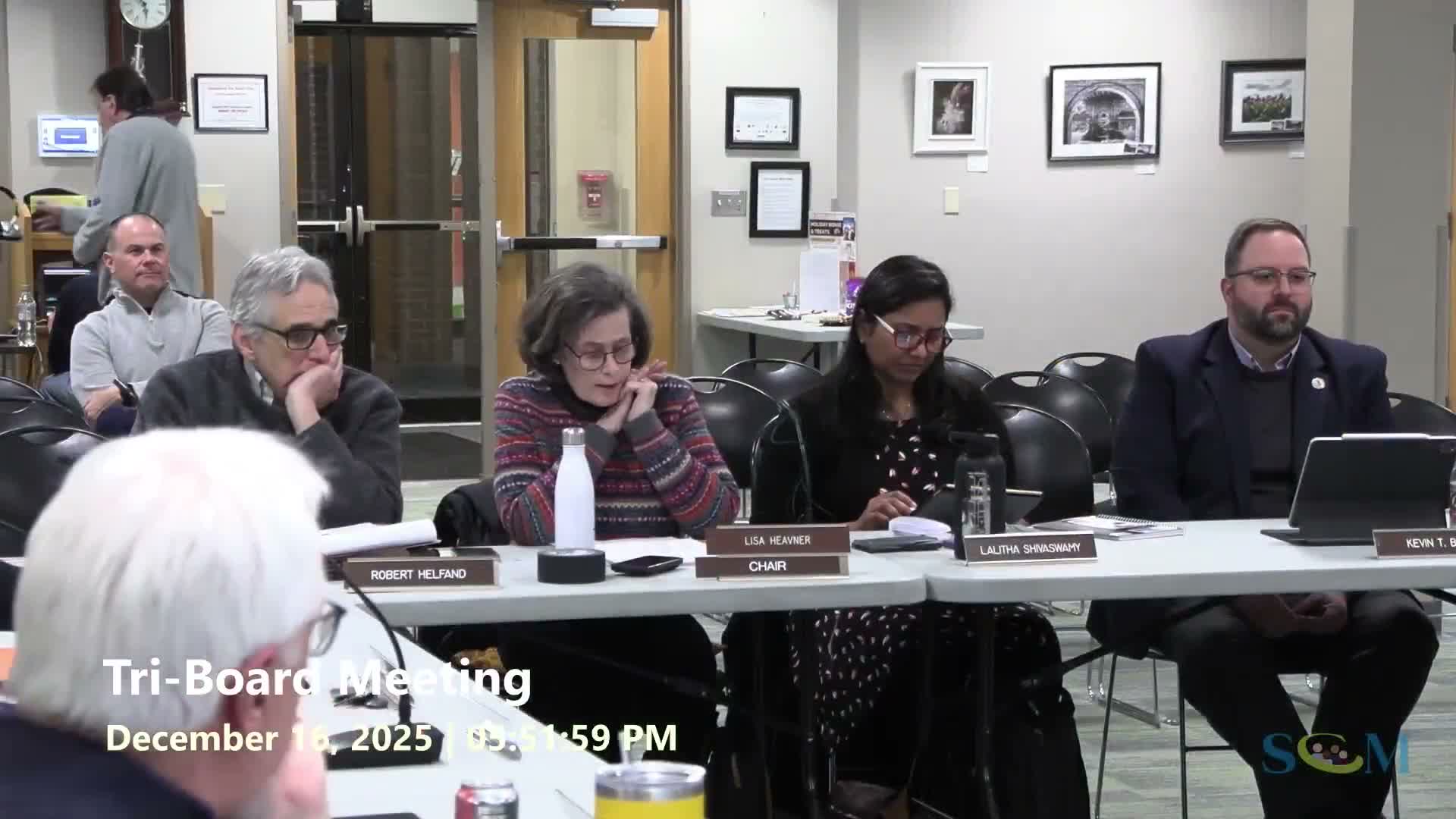
Summary
At a joint meeting, Simsbury officials previewed FY2027 budget assumptions showing a projected 4.3% tax increase under current estimates, outlined tools (reserves, health‑insurance funds, targeted cuts) to lower the rate, and said a roughly $2 million gap must be closed to reach a 2% guidance target.
Chair Lisa Hevner opened a joint session of the Board of Finance, Board of Selectmen and Board of Education to present early FY2027 budget estimates and the choices the town faces.
Hevner told the assembled boards that the town will finalize key revenue numbers in February but that the first estimate points to a preliminary tax increase near 4.3% under current assumptions. She said the town relies heavily on property taxes — about 87% of operating revenue — and that education accounts for roughly 69% of the budget, making school costs a central driver of the mill rate.
Officials identified two principal cost drivers: salaries and health insurance. Hevner noted healthcare costs in the projections are rising materially and that debt service — which cannot be cut once bonds are issued — has increased sharply in recent years. “We are legally required to adopt a balanced budget,” Hevner said, noting that debt service is a fixed obligation that limits budget flexibility.
Staff presented revenue assumptions from the assessor and finance director. The assessor’s preliminary grand‑list growth projection for FY2027 was 0.46%, producing about $500,000 in new revenue; staff cautioned those numbers may change when the governor’s revenue estimates and final assessor numbers arrive in February. Hevner said a combination of better revenue or about $1.5 million in reductions would be needed to reach a 2.8% tax‑increase target, and roughly $2.3 million in reductions to get to a 2% target; achieving a zero tax increase would require about $4.4 million in reductions.
The board reviewed available tools to lower the tax impact: modest use of capital reserves, a limited draw from health‑insurance reserves if consultant advice supports it, one‑time revenues for capital rather than recurring operations, targeted operating budget reductions, and pursuing grants or fee changes. Hevner cautioned against overreliance on one‑time volatile revenues and urged a structurally balanced approach.
Officials also highlighted a notable positive: the town’s OPEB (other post‑employment benefits) trust is now fully funded and, if used according to the actuary’s recommendations, is projected to yield more than $20 million in savings over 20 years. Hevner described that as an opportunity to reduce long‑term volatility but stressed it does not remove near‑term budgeting constraints.
The boards agreed to continue discussion through the budget season, with the board of finance set to vote on preliminary guidance once February revenue updates arrive.