Get Full Government Meeting Transcripts, Videos, & Alerts Forever!
Get email alerts on the Utility Rates topic
No spam. Unsubscribe anytime.
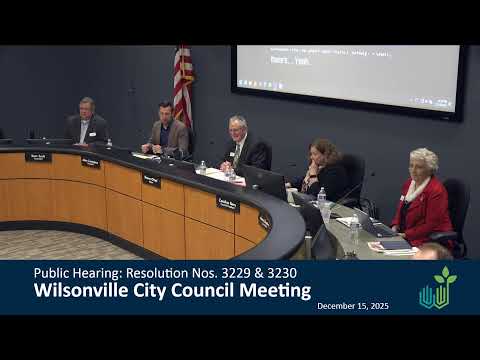
Wilsonville council pauses decision after hours of public opposition to steep sewer and stormwater increases
Summary
After a four‑hour public hearing with dozens of residents and repeated council questions about affordability and growth assumptions, the Wilsonville City Council continued consideration of proposed multi‑year sewer and stormwater rate increases to Feb. 2, 2026, and asked staff for more scenarios, affordability analysis and grant/financing options.
Wilsonville — The City Council on Dec. 15 declined to adopt proposed multi‑year sewer and stormwater rate increases after a lengthy staff presentation and heavy public turnout, voting 5–0 to continue the hearing until Feb. 2, 2026.
Zach Weigel, Wilsonville’s city engineer, and Zach Hazel of FCS Group presented a three‑part rate study — revenue requirement, cost‑of‑service and rate design — that staff say is driven by a front‑loaded capital program identified in 2024 master plans and by construction‑cost inflation. Weigel said the plans call for large projects in 2026–2030 and that without changes “we cannot afford the rising costs of the utility” without additional rate revenue.
The recommended schedule would phase increases over several years and add an annual inflation adjustment after the package is completed; staff also proposed discontinuing a stormwater exemption that currently covers about 122 residences. Weigel said system‑development charges (SDCs) fund growth over time but noted near‑term financing needs will require revenue bonds and rate revenue to cover debt service.
The meeting drew long public testimony. Residents — including seniors on fixed incomes, long‑time homeowners and local business owners — urged the council to delay action and to explore alternatives such as phasing projects farther out, pursuing federal or state grants, targeting relief for low‑income households, and examining which capital projects are strictly necessary now. “These increases are a burden on seniors and low‑income renters,” said Libby Crawford, whose daughter on the autism spectrum is budget‑sensitive. “An extra $30 to $100 a month can be make‑or‑break.”
Several speakers questioned the population and growth assumptions used in the sewer master plan and whether projected development (Frog Pond, Town Center) will materialize on the timeline staff used. Council members echoed callers’ concerns. Councilor Cunningham asked if staff could supply an affordability analysis; Councilor Scholl asked whether some projects could be delayed or reduced to smooth increases. Council President Berry and others pressed staff on alternatives to immediate borrowing and on options for targeted mitigation.
After discussion, Councilor Cunningham moved to continue the hearing to Feb. 2, 2026, at 7 p.m.; the motion was seconded and passed 5–0. In continuing the hearing, council specifically directed staff to return with additional scenarios and analyses requested during the meeting, including:
- An affordability analysis showing impacts by household income and housing type; - Alternative project schedules and risk assessments for deferral; - A clearer accounting of SDCs, revenue bonds and timing; and - Information about grant opportunities and other external funding sources.
What’s next: The council will reconvene the public hearing Feb. 2, 2026, at 7 p.m. Staff told council they will circulate the requested analyses in advance so residents can review them before the continued hearing.
Sources: City staff presentation and rate study (staff: Zach Weigel, city engineer; Zach Hazel, FCS Group); public testimony at the Dec. 15, 2025 City Council meeting.
Ending: The council did not take a final vote; it continued the hearing and asked for additional detail and scenario options to better weigh infrastructure needs against immediate affordability concerns.