
Commission approves amended order for 13A Willard after inadvertent encroachment; mitigation required
Get AI-powered insights, summaries, and transcripts
Subscribe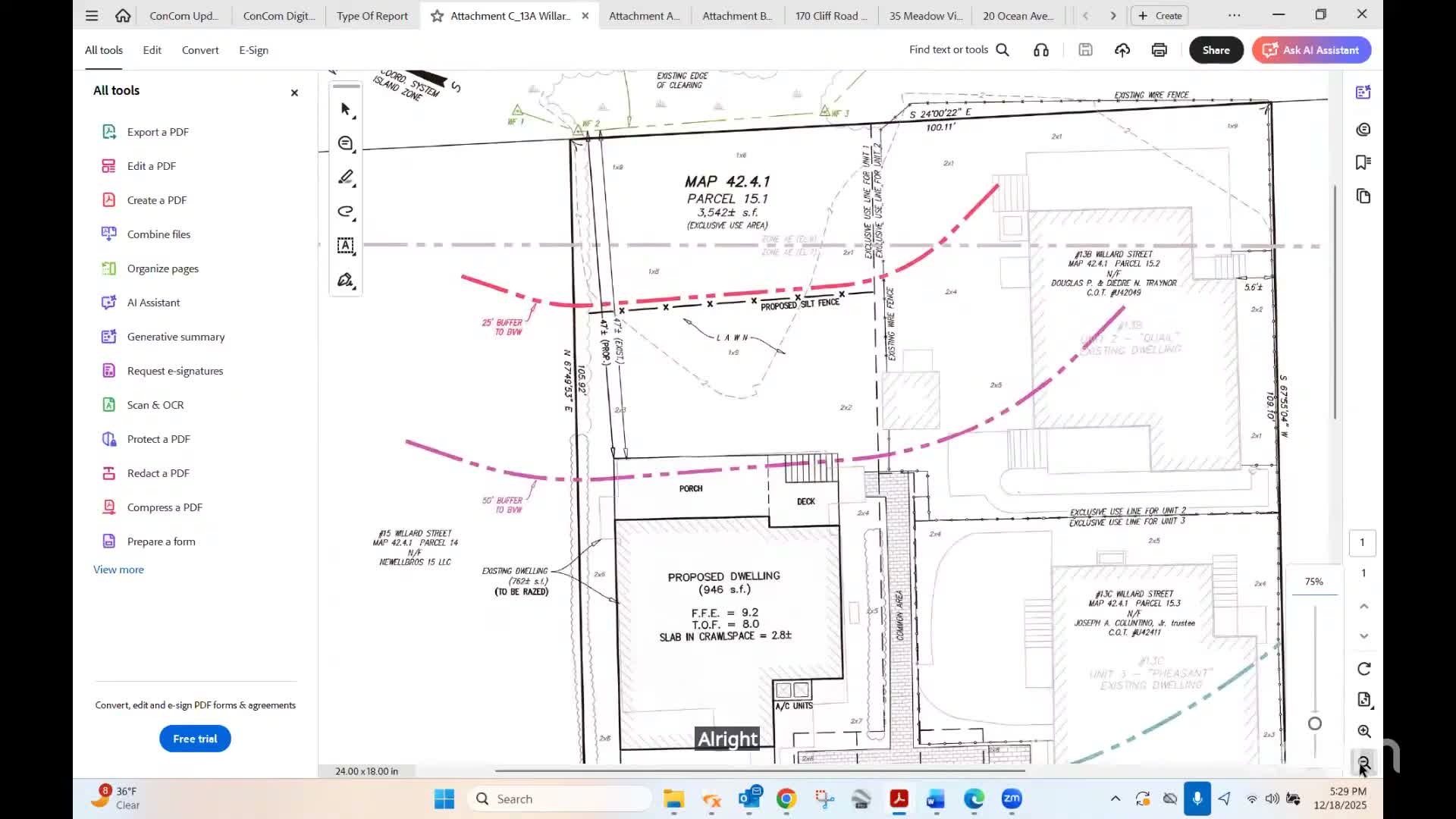
Summary
After an applicant built a cantilever/porch slightly closer to a resource area than permitted, the commission approved an amended order of conditions requiring a 300 sq. ft. native‑plant mitigation area (about a 4:1 ratio) and monitoring with supplemental planting if survivability targets are not met.
The Nantucket Conservation Commission on Dec. 18 approved an amended order of conditions for work at 13A Willard (Howard Living Trust) after learning the as‑built structure was constructed 2.3 linear feet closer to the resource area than the approved plan. Brian Madden of LEC Environmental said the discrepancy resulted from construction following an earlier HDC layout rather than the final approved cantilever design.
The applicant proposed mitigation that includes creating a 300‑square‑foot native‑planting area on the back lawn and infilling a historical encroachment onto adjacent conservation property; the combined revegetation was described as producing roughly 600 square feet of restoration in total and a mitigation ratio slightly greater than 4:1 for the 74 square feet of unpermitted structure.
Commissioners and staff discussed monitoring language and agreed to a survivability requirement: if monitoring reports show less than 50% native regrowth within two years and six months, the commission shall require the applicant to supplement plantings. The amended order includes conditions requiring native species (no cultivars) and annual monitoring reports with photographs until a certificate of compliance is issued.
The commission voted to approve the amended order with the mitigation and monitoring conditions; staff said they would follow up on implementation and require additional plantings where monitoring shows insufficient survivability.