Get Full Government Meeting Transcripts, Videos, & Alerts Forever!
Get email alerts on the Massage Ordinance Update topic
No spam. Unsubscribe anytime.
Santa Barbara committee hears police proposal to update massage ordinance; item continued after extensive public comment
Summary
Police and city attorneys proposed a rewrite of the city's massage ordinance to align with state CAMTC rules and add enforcement tools (employee rosters, live‑scan, inspections). Many massage practitioners and immigrant‑rights groups opposed parts of the draft; the committee continued the item to Jan. 13 to allow further review and revisions.
The Special Ordinance Committee on Dec. 16 heard a multi‑hour presentation and extensive public comment on a proposed update to the City of Santa Barbara's massage ordinance intended to align local code with the state Massage Therapy Act and to provide police and staff additional enforcement tools.
City Attorney Duimas and police staff framed the rewrite as an update to a 1976 ordinance that does not reflect current California law and that lacks effective administrative tools to address illicit activity in some establishments. Police presenters said the changes are intended to protect legitimate massage businesses while creating mechanisms—annual inspections and complaint‑driven unannounced inspections, employee rosters, live‑scan background checks for administrative staff, display requirements for permits and CAMTC certificates—to identify and address establishments that enable trafficking or prostitution.
Assistant City Attorney Heather Minter summarized state requirements under the CAMTC framework, including the 500‑hour minimum education standard for certification and the CAMTC role as the statewide certifying body. The draft ordinance includes a limited exception certification pathway for existing practitioners and a multi‑year compliance timeline: staff incorporated a limited‑exception extension through 12/01/2028 and said CAMTC certification would be required by 01/01/2029 under the draft language discussed.
Presenters said proposed fees would be $375 annually per massage establishment and $275 for sole proprietors (sole proprietor permit renewal proposed every two years). Staff described those charges as cost‑recovery for inspections and administration rather than revenue generation.
Public comment was substantial and split along two primary lines. Practitioners, vocational schools and business owners urged changes to avoid displacing longstanding therapists who trained under prior (250‑hour) standards, questioned the feasibility and fairness of the 500‑hour CAMTC requirement, and asked the city to reconsider or broaden limited exceptions (speakers included representatives of local massage schools, sole proprietors, and industry groups). Several practitioners urged slowing the process so schools and workers could adapt.
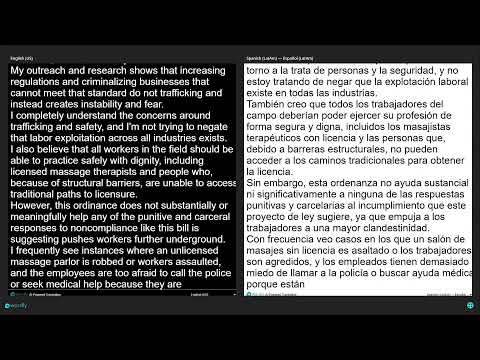
Worker‑advocacy and immigrant‑rights organizations urged the committee to reject or substantially revise the ordinance, arguing complaint‑driven unannounced inspections and expanded police contact would increase surveillance of already‑vulnerable Asian immigrant workers and could result in arrests, deportations, displacement, confiscation of property and reduced worker safety. Callers urged non‑carceral alternatives (language access, labor protections, housing and outreach) and questioned whether administrative inspections would be weaponized through frivolous or retaliatory complaints.
Beverly May, Governmental Affairs and Human Trafficking representative from the California Massage Therapy Council, told the committee CAMTC does not ask about immigration status in certification and said CAMTC has worked with cities to implement best practices; she suggested further refinement of the draft ordinance to respond to public concerns.
Given the complexity and the number of public commenters, the committee agreed to continue deliberations. Mayor Rouse moved to continue the item to Jan. 13 with public comment reopened; Councilmember Gutierrez seconded and the committee voted Aye (Mayor Rouse Aye; Councilmember Gutierrez Aye; Chair Sneddon Yes). The committee adjourned for the day.
What’s next: Staff indicated they will revise the draft with input and return to the committee on Jan. 13 to reopen deliberations and public comment.
Notable quotes: Assistant City Attorney Heather Minter summarized the CAMTC standard: "a person must complete a minimum of 500 hours of education" and the proposal’s timeline for CAMTC compliance; multiple commenters warned the ordinance "will criminalize and severely harm migrant Asian massage workers," arguing the policy could drive victims underground and exacerbate deportation risk.
Who said what: Police presenters included the department’s presentation team (Commander Miller and police coordinator Jocelyn were named in the presentation); Assistant City Attorney Heather Minter provided statutory context; numerous public commenters (practitioners, school directors, immigrant‑rights advocates and CAMTC representatives) participated in person and online.