Get Full Government Meeting Transcripts, Videos, & Alerts Forever!
Get email alerts on the Trail Infrastructure topic
No spam. Unsubscribe anytime.
East Coast Greenway presenter outlines Connecticut progress, major corridors and funding priorities
Summary
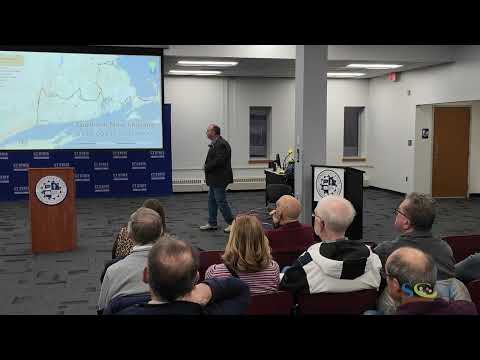
At a Simsbury Center presentation, the East Coast Greenway presenter summarized Connecticut trail progress, named near‑term construction projects and funding sources, warned of legal bottlenecks on some segments and highlighted a DOT feasibility study near Danbury.
Presenter opened the session by framing the East Coast Greenway's long‑term mission and saying Connecticut’s spine is now about 37% complete. He said the organization published a five‑year “Accelerate Connection” strategic plan that functions largely as a marketing roadmap and that separate work plans show how staff and partners move projects to construction.
The presentation identified a roughly 204‑mile corridor through 29 towns and four major cities in the region and outlined staffing and regional priorities. The presenter said the Greenway aims to reach 74.5% spine completion in Connecticut by 2030 and highlighted discrete project phases — initiation and feasibility, design and permitting, then construction.
He reviewed a project spreadsheet with items slated for the next few years: pieces of the State Street cycle track in New Haven, local off‑road segments in Fairfield, a 1.1‑mile Airline–Putnam connector, and multiple smaller segments in Manchester, Hartford and Bloomfield. The presenter noted that listed projects include dollar figures only when funding has been identified and said, “that’s all funded” for a set of Connecticut projects shown on the slide.
On regional connectors, the presenter said the New Haven‑to‑Boston spine portion is nearing completion (about 88% complete) and described the Southern New England Trunk Line (SNET) as a Massachusetts Department of Conservation and Recreation state park trail undergoing staged rebuilding. He contrasted those completions with the proposed Merritt Parkway route, which he said currently lacks political will and off‑road alignment through town centers.
The presentation also highlighted a prospective Danbury‑area feasibility study for a western connection, which the presenter said has a verbal Connecticut DOT commitment for approximately $500,000 to start a study next year; he cautioned that the money had not yet been received in hand.
Economic analysis and promotion were a second theme. Presenter cited a Cambridge Econometrics study that used Connecticut Trail Census data to estimate current Canal Heritage Trail use (the study noted roughly 800,000 users; the presenter said his internal estimate is about 1,000,000). The consultant work also flagged promotion and completion as key drivers of future ridership and local spending.
Safety and design topics included a DOT pilot of raised crossings (traffic tables) to slow vehicles at trail crossings and new AASHTO guidance on trail widths and bollard placement. The presenter said the raised crossings are intended both to calm traffic and to evaluate public reaction.
He closed by encouraging attendees to promote trail use to legislators and state tourism officials and by announcing the next East Coast Greenway ride (06/27/2026).
The presentation recorded progress and challenges without any formal motions or votes; several projects were reported as DOT‑funded or DECD‑funded, while others remain contingent on federal grant programming and local approvals.