Get Full Government Meeting Transcripts, Videos, & Alerts Forever!
Get email alerts on the School Budget topic
No spam. Unsubscribe anytime.
Dover Area SD: state aid and ESSER boost revenues, but unbudgeted cyber and special-ed costs pushed spending above the adopted plan
Summary
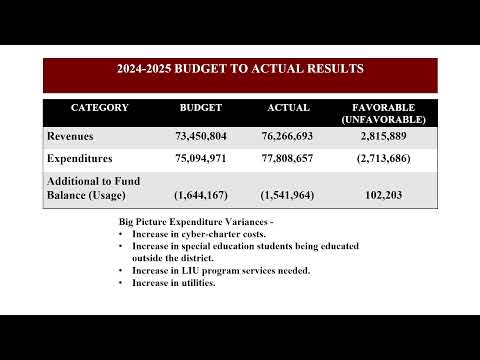
Dover Area SD finance staff reported about $1.3 million in additional state revenue and roughly $1.3 million in federal/other timing-related receipts, but higher-than-expected tuition for outside cyber programs and special-education placements contributed to nearly $2.7–$2.8 million in net spending variance against the adopted $75 million education budget.
Dover Area SD finance staff told the school board that the district ended fiscal 2024–25 with more revenue than expected but also higher spending driven largely by out-of-district tuition and special-education costs.
Mrs. Weaver, the presenter for the district’s results of operations, said the district used about $100,000 less of its fund balance than originally projected when the 2024–25 budget was adopted. She reported roughly $1.3 million in additional state revenue — including about $96,000 in the basic education subsidy and $145,000 in the special-education subsidy — and another approximately $1.3 million of federal and other receipts, “mostly because of ESSER funding” and timing of device deliveries.
The extra state money and federal timing receipts were largely offset by several unbudgeted or higher-than-expected costs, district staff said. Mrs. Weaver identified major expenditure variances including nearly $900,000 in additional costs tied to students who enrolled in outside cyber charter programs and higher tuition for placements through the local intermediate unit. She also cited an increase in debt-service costs of about $158,000 and higher utility and transportation charges.
Board members pressed staff for a simple net number after accounting adjustments. Mrs. Weaver agreed that timing-related items (ESSER and delayed device deliveries) create budget variances but said the related expenditures appear in the same year, so the items net to zero for fund-balance purposes under Governmental Accounting Standards Board (GASB) rules. After those adjustments, she said the district’s actual net improvement over budget was roughly $1.5 million, though the board also heard that year-end spending for education totaled about $78 million against an adopted $75 million plan.
Several directors questioned how the district could exceed the approved spending level without a formal supplemental authorization. One board member said the process felt “meaningless” when unanticipated revenues and mandatory costs produce large swings in the final totals. Mrs. Weaver and other speakers responded that many costs are outside local control — for example, state law requires the district to provide services to students who move into the district and to meet spelled-out special-education requirements — and that the budget still governs discretionary purchases.
The presentation included several line-item clarifications: local receipts exceeded estimates by about $251,000, driven in part by an unexpected $630,000 in earned-income-tax receipts and smaller gains from realty transfer and interest; the district received roughly $553,000 in Ready to Learn (adequacy) funding tied to the recent state budget; and a roughly $238,000 drop in access-fund reimbursements reduced federal receipts for specialized transportation. Mrs. Weaver said the district’s fund balance was about $15 million as of June 30.
On the topic of school resource officers (SROs), staff explained that an accounting timing issue made a payment appear as an additional expenditure in 2024–25; finance corrected the booking so future SRO service costs will align with the period the service is provided.
Board members asked staff to calculate the net fiscal effect of the district’s in-house cyber program versus sending students to outside cyber charters; staff said they would dig into the numbers. Mrs. Weaver and other speakers noted the in-house program costs considerably less per student than many outside cyber providers, but they acknowledged enrolling students who move to outside providers created unbudgeted expense pressure this year.
The board did not take any vote on budget amendments during the presentation. The district said it will follow up with detailed calculations about cyber-program cost mitigation and provide any requested additional breakdowns of state and federal revenue impacts.