Get Full Government Meeting Transcripts, Videos, & Alerts Forever!
Get email alerts on the Narrative Requirements topic
No spam. Unsubscribe anytime.
Clark County staff outline what narratives must show for land‑use reviews
Summary
Clark County Land Use staff advised applicants that written narratives are required for Type 1–3 land‑use reviews, must address applicable Title 40 criteria, explain how pre‑application issues are resolved, and be consistent with plans; staff also explained submission procedures and answered questions about revisions and phasing.
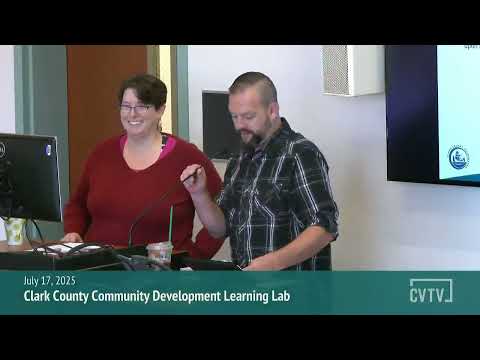
At a Clark County Land Use Program workshop, county staff walked applicants through what must be included in written narratives for land‑use applications and how narratives are used in review decisions. "A written narrative shall be submitted that addresses the following," said Joe Kinsman, a planner with the Land Use Program, listing how the application meets approval criteria and how pre‑application issues are addressed.
Kinsman and Michelle Dawson, an engineer with the county's Development Engineering Program, emphasized that narratives are evidence documents, not promotional essays. "The narrative we are asking for is not a story, but factual statements addressing each applicable code section to the proposed development," Dawson said, adding that applicants should reference supporting documents by title and page so reviewers can verify claims.
Why it matters: county staff use narratives to determine whether an application meets the county's legal standards (for example, Title 40 and related titles). Kinsman said applicants bear the burden of proof to demonstrate compliance; statements in a narrative and the plan set must be consistent because "if you state something in your narrative or plan, it will be required as a finding or condition."
What to include: staff listed specific items that should be addressed in a narrative — project name; site location, zoning and parcel size; proposed and existing uses; density or building size; parking and access; environmental sensitive areas; landscaping and screening; stormwater and lighting; phasing plans; and hours of operation or capacity where relevant. Kinsman said the narrative must explicitly address each applicable approval criterion and explain why any code section the applicant considers irrelevant is not applicable.
Review types and examples: Dawson explained Clark County uses Type 1–3 reviews (Type 1 generally least intensive). She gave examples: certain home businesses or lot determinations may be Type 1; short plats of 2–9 lots in urban zones or commercial site plans may be Type 2; subdivisions of 10 or more lots in urban zones and some conditional use permits may be Type 3.
Drafting guidance: staff recommended seven drafting practices including: identify the relevant code; apply facts to the code; provide all relevant facts; "show your work" so reviewers can follow reasoning; use 'because' to connect conclusions to evidence; do not assume reviewers know background; and keep the narrative focused on applicable legal standards. Dawson said these techniques reduce back‑and‑forth revisions and shorten review timelines.
Common errors to avoid: examples included failing to reference applicable code sections, asserting compliance without explaining how, submitting opinion‑based narratives, or asking for variances without addressing applicable approval criteria. Staff warned that each time an item is requested and resubmitted it can add review time (staff cited up to about 14 days per additional submission request).
Submission details and resources: Dawson said Clark County now accepts digital submittals only and listed acceptable file formats. She referenced a county Learning Lab video (July 2025) that covers submittal procedures and naming conventions, provided a general contact email (landuse@clark.wa.gov), and noted a rotating planner aims to respond within about 24 hours.
Q&A highlights: in the question period, staff said opportunities to revise depend on the review type and the stage of review — Type 1 applicants typically receive a complete or not‑complete determination at 21 days, while Type 2 and 3 reviews include an early issues step for revisions. On phasing, Kinsman explained each approved phase is evaluated to stand alone against code criteria, though some standards (for example, transportation concurrency) may evaluate the whole project rather than individual phases. On late revisions, staff said substantive changes late in the process may require a hold so interdependent items can be reworked.
Next steps: the session closed with a notice that the county's next workshop, "Code Enforcement 101," will be presented by Scott Melville and Sydney Valer on the third Thursday of next month at 11 a.m.