Get Full Government Meeting Transcripts, Videos, & Alerts Forever!
Get email alerts on the Codes Enforcement topic
No spam. Unsubscribe anytime.
Doña Ana County explains how environmental codes enforcement works, from education to abatement
Summary
Doña Ana County codes officers said their unit focuses on public-health and quality-of-life enforcement across about 3,800 square miles, prioritizing voluntary compliance through education, temporary cleanup help and partnerships before pursuing abatement, liens or criminal charges.
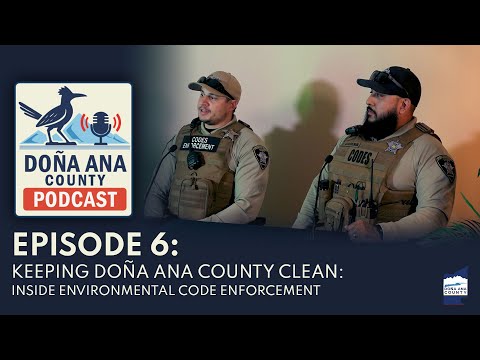
Joseph Vargas, the county’s multimedia coordinator, opened a Doña Ana County podcast episode by asking staff how environmental codes enforcement operates. "We're a service based department first," said Jonathan Davis, who spoke for enforcement, adding that officers aim to "protect and serve the citizens of Doña Ana County" while addressing public-health and nuisance concerns.
Davis said the county has about seven environmental codes officers covering roughly 3,800 square miles, from Garfield and the Hatch area in the north to Santa Teresa on the U.S.–Mexico border. The officers respond to central-dispatch calls, citizen complaints and perform proactive patrols in both populated and desert areas.
Brannikavena, introduced on the program as being "from Doña Ana County Environmental Codes," described common enforcement work on Bureau of Land Management parcels and illegal-dumping investigations. "We post signs notifying them that the areas are under surveillance," Brannikavena said, and staff will place cameras, review footage and, if they obtain probable cause, pursue illegal-dumping charges in magistrate court.
The guests said the division focuses on quality-of-life issues such as solid-waste accumulation, weeds and inoperable vehicles. Davis referenced county ordinance sections commonly used in enforcement: section 2-87 for solid waste and section 3-12 for inoperable vehicles. When the department receives a complaint—through Mesquite Valley Regional dispatch or an in-person filing at the Community Development Building—staff perform a field inspection, photograph the condition and issue a violation notice.
Under the county process described on the podcast, a violation notice gives property owners 30 days to come into compliance. Brannikavena said staff frequently pursue nonpunitive options first, including time extensions and operational assistance: "We can set up what's called an ACEs Plus, where we can set up a roll-off dumpster in a government area of anywhere that the general public has access to," which allows residents to dispose of accumulated material without placing equipment on private property.
If voluntary compliance efforts fail, the department may seek abatement approval from the Board of County Commissioners. Brannikavena said commissioners review the violations and previous outreach efforts; if they approve abatement, property owners have 15 days to appeal before the county proceeds to clean the site or hire a contractor. The county places a lien for cleanup costs on the property; Brannikavena said owners typically have about three years to repay that lien, and failure to pay can lead to foreclosure and auction to recoup costs.
Separately, the county may pursue criminal charges in magistrate court for certain violations. Brannikavena noted prosecutorial timelines: "We only have, as the prosecutors, only six months to prosecute a crime in magistrate court," but defendants can waive that timeline and extend proceedings, sometimes turning cases into multi-year processes.
Both Davis and Brannikavena emphasized an education-first approach. "We want compliance voluntarily at the end of the day," Davis said, noting that staff frequently connect residents with resources so compliance is achieved without enforcement action. The episode closed with Vargas thanking the guests and directing listeners to the podcast's Spotify, Apple Podcasts and YouTube locations for audio and video versions.
The program provided practical timelines and program names used by county staff, but did not specify details such as the full name or formal description of the "ACEs Plus" roll-off program, the exact number of cases that reach abatement or prosecution annually, or the specific criteria the county uses to decide between criminal charges and abatement.