Get Full Government Meeting Transcripts, Videos, & Alerts Forever!
Get email alerts on the Infrastructure Water Sewer topic
No spam. Unsubscribe anytime.
Seaford holds first-round public hearings on SRF-funded sewer relocation and Nylon well project
Summary
City staff presented first-leg public hearings on three SRF-funded projects: Martin Farms Phase 2 sewer ($2.07M loan at 2% with partial forgiveness) and water ($1.25M with ~$388,902 principal forgiveness), and a $2.7M Nylon well project with 100% principal forgiveness; council questions focused on timing, aquifer safety, PFAS and radium risks.
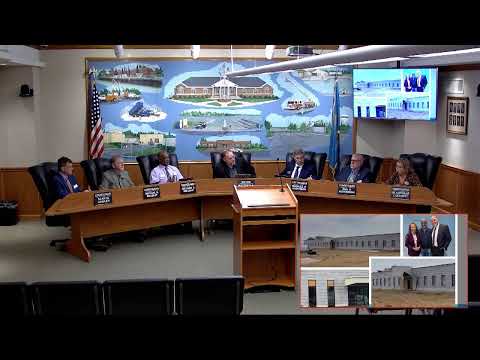
City staff presented first-leg public hearings on Nov. 25 for several State Revolving Fund (SRF)–eligible water and sewer projects, outlining loan terms, principal forgiveness and projected schedules but taking no final votes. Director Mears described the Martin Farms sewer relocation Phase 2 as a $2,070,000 SRF loan with a 20-year term at 2% interest; the related Phase 2 water portion was listed at $1,250,000 with state principal forgiveness of roughly $388,902 and an approximate remaining balance of $861,098 to be amortized over 20 years. Mears said the state issued a binding commitment letter that requires loan closing within 120 days but indicated the state will amend that deadline to allow closing in July 2026 so the city can place the expense in the FY27 budget.
Mears also presented the Nylon well project as a roughly $2.7 million SRF-funded effort for two new production wells and related treatment and buildings; the state award included 100% principal forgiveness for that project. He said the town has lost two production wells (Nylon and Delaney) and is pursuing deeper wells in a confined aquifer to address both supply concerns and PFAS exposure risk. "We were down to three operational wells," Mears said, adding that deeper test wells show somewhat lower yield but different chemistry and that the design team is considering noise mitigation for treatment buildings.
Council members asked technical and safety questions. Vice Mayor Dan Henderson pressed on aquifer safety after a radium-contaminated well was found about 1,000 feet away: "My concern is if there’s radium there, what's to say the plume won't go to some of these other wells?" Mears responded that the state requires sealing technology when drilling through unconfined layers and that state geologists had not observed the same radium readings at other local wells. Council members also questioned well capacity, projected gallons per minute, and potential noise impacts; staff said the deep wells tend to have higher pH and lower yields and that the town may need multiple new wells.
Staff recommended bidding and possibly packaging phases together to lower mobilization costs, with an estimated timeline of design by April, bid in June, contract award in August and construction beginning in October 2026 with completion possibly by September 2027 for the Nylon project. These items were presented as the "first leg" of public hearings and are scheduled to return to council on Dec. 9 for the second-leg hearings; if council decides to proceed then, resolutions adopting the loans would be required.