Get Full Government Meeting Transcripts, Videos, & Alerts Forever!
Get email alerts on the Facility Planning topic
No spam. Unsubscribe anytime.
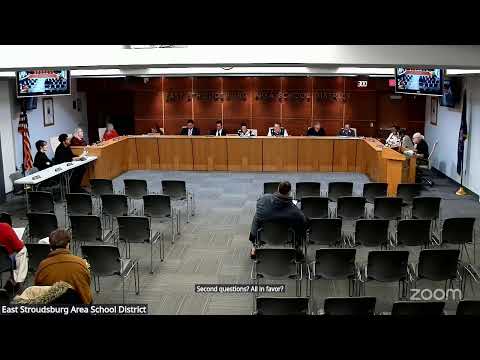
East Stroudsburg board hears five feasibility options; parents urge keeping JM Hill open
Summary
Consultants presented five district-wide options — from status quo to grade reconfiguration and a ninth-grade academy — and scheduled a Jan. 10 town hall; dozens of residents urged the board not to close JM Hill Elementary, citing transportation, special-needs supports and neighborhood impact.
Consultants from RLPS Architects presented five feasibility options to the East Stroudsburg Area School District on Dec. 15, outlining paths that range from ‘‘do nothing’’ maintenance (Option A) to redistricting and possible school consolidations, including a proposal that would remove J.M. Hill Elementary from the district’s elementary mix (Options B–E). Chris Linke of RLPS said the study began in June, used PlanCon capacity figures and an 80% utilization target, and will be refined after a Jan. 10 public town hall at J.T. Lambert and a community survey. RLPS said it expects to return in February with narrowed options and community feedback.
Why it matters: The options carry long-term implications for building use, student transportation and program offerings. Board members and residents repeatedly raised practical concerns — including how students would be phased during construction, whether a renovation would require capital bonding, and how special-education services and extracurriculars would be maintained if schools are consolidated.
At the meeting, RLPS described Option B as redistricting plus rebuilding or renovating J.M. Hill; Option C as rightsizing the district by operating five elementary schools rather than six; Option D as a districtwide realignment that would create an intermediate 5–8 configuration and potential magnet tracks; and Option E as a model incorporating a ninth-grade academy at J.T. Lambert. ‘‘We use PlanCon part A and start from October 2025 enrollment,’’ an RLPS presenter said, adding that the consultant team organized priorities using the MoSCoW method (must/should/could/won’t). The presenters recommended treating the exercise as exploratory and emphasized phasing and community input.
Public reaction focused on J.M. Hill. Dozens of residents — parents, former board members, borough officials and special-education advocates — urged the board not to close the neighborhood school. Kyle O’Connell, a parent, said he came to ‘‘add my voice’’ to those who want to keep J.M. Hill. Other commenters said the school provides walkable access to before- and after-school programs, imperative supports for students with disabilities, and community cohesion that might be lost if the building were emptied. One resident asked that any closure option include a specific reuse plan for the property to prevent long-term vacancy and loss of property value.
Data questions and next steps: Multiple board members asked RLPS to clarify capacity and PlanCon numbers (examples discussed included 935 for Middle Smithfield and near-1,000 for East Stroudsburg Elementary), and consultants confirmed they used an 80% utilization target to allow space for specialized programs and curriculum expansion. The district’s superintendent and consultants said the Jan. 10 town hall will be livestreamed and Zoom access will be available; residents may submit questions in advance. After the town hall and the survey, RLPS will report back in February with community input and recommended next steps.
What remains unresolved: The consultants and administration did not present detailed renovation cost estimates for J.M. Hill at the meeting; several speakers and board members requested specific cost figures and a class-size ‘‘waterfall’’ showing how students would be redistributed under each option. Officials said those details will be developed as the process continues.
The board did not make any final decisions on school closures or redistricting at the meeting; it moved the feasibility study forward for additional public engagement and study.