
PUC technical conference: Public Service presents near-term procurement portfolio; commissioners press on transmission costs, tax credits and backup bids
Get AI-powered insights, summaries, and transcripts
Subscribe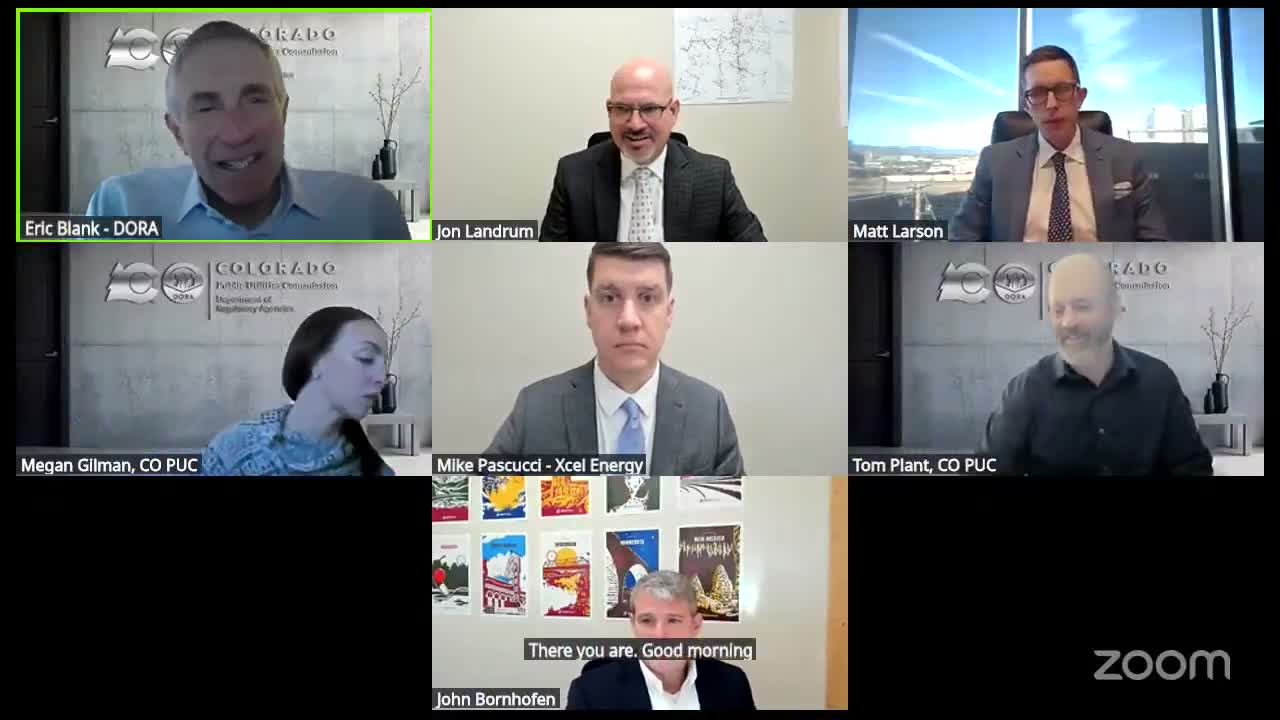
Summary
Public Service presented a recommended near-term procurement portfolio after receiving 161 bids from 135 projects and urged accelerated approvals to capture federal tax credits. Commissioners focused on high gas bid prices, delivery and interconnection uncertainty, an indicative $2—$2.5 billion deliverability estimate (and broader JTS transmission needs of about $12.5 billion), and how backup bids or option payments should protect tax-credit value.
Public Service Company outlined a recommended near-term procurement (NTP) portfolio at a Colorado Public Utilities Commission technical conference on Dec. 18, telling commissioners that the company received “161 bids from 135 unique projects, and 52 bidders participated,” and that its recommended tiered list includes selected projects plus a robust set of backup bids to move quickly on tax-credit deadlines. Chair Eric Blank framed the day as a four-phase technical conference, with company overview, commissioner questioning, intervenor questioning, and follow-up periods.
The company's resource planning director, John Landrum, said the selected tier-1 package totals several thousand megawatts of nameplate capacity and roughly 1,200 accredited megawatts, with an ownership mix the company described as about 42% utility-owned and 58% PPAs by nameplate. Landrum said the company used price sorting and a rapid due-diligence sweep to form the portfolio and a sizeable backup list to respond quickly if winners fail to reach required milestones.
Commissioners repeatedly pressed Public Service on deliverability and cost uncertainty. The company reported an indicative DC power-flow (deliverability) screening that shows the portfolio would require "reasonably significant transmission upgrades" to deliver generation into load centers; Landrum described that short-term deliverability estimate as roughly $2 billion to $2.5 billion. Commissioners contrasted that with broader estimates developed in the Joint Transmission Study (JTS) phase 1 modeling, which the company and staff have previously discussed as a multi‑billion-dollar program (the record modeling cited in the hearing referenced a long-range transmission forecast in the order of $12.5 billion through 2031). Landrum said the company will refine line-by-line work as formal studies proceed and that timing — not whether transmission will be needed — is central to the company's recommendation.
Tax-credit timing and safe-harbor actions were a second focus. Several commissioners and intervenors said they want mechanisms that preserve developers' ability to qualify projects under federal start-of-construction rules. The chair and multiple parties proposed options such as short-term option payments or a broader incremental-need-pool (INP) approach to encourage developers to order long-lead equipment such as main transformers; Public Service said it will consider those mechanisms but cautioned that many developers already hold safe-harbored equipment and that option payments might not, by themselves, be sufficient to cause a developer to place multi-million‑dollar equipment orders. The company said it will work with parties on possible designs for option payments or exclusivity provisions if the commission requests them.
Price and technology questions dominated the public questioning. Commissioners asked why median gas-bid prices were materially higher than in earlier RFPs; Landrum agreed that gas-equipment and turbine prices have risen substantially and said supply-chain pressures, competing industrial demand (including data centers), and international purchases have pushed up prices. Commissioners also dug into how the company treated interconnection cost estimates in Appendix A: the company said it used benchmarking and indicative transmission-team estimates during due diligence and included representative POI network-upgrade costs where bidders did not supply them, with the caveat that detailed interconnection studies remain pending and that numbers may change after formal study.
On storage, Landrum cautioned that the accredited capacity value (ELCC) of four-hour batteries declines as cumulative volume grows; the company said the portfolio was chosen with attention to ELCC saturation and operations needs and stressed that a variety of locational values (for example, storage inside the Denver metro constraint) require full JTS modeling to quantify precisely.
Next steps: commissioners and parties moved to a highly confidential session to review commercial details (interconnection costs, bid-level capacity factors and some permitting status). Public Service said it will provide additional materials where feasible (for example, capacity‑factor detail in Appendix A or bidder-specific LEC/workpapers where it is not privileged) and will bring additional subject-matter witnesses for finance and transmission questions in follow-up sessions.
The technical conference does not make final policy decisions; it is an evidentiary step to inform later orders and the JTS. The commission and parties scheduled further confidential review and follow-up public sessions in the days ahead.