Get Full Government Meeting Transcripts, Videos, & Alerts Forever!
Get email alerts on the Pine Beetle Outbreak topic
No spam. Unsubscribe anytime.
State entomologist warns beetle outbreak is spreading on Front Range; council weighs incentives, wood‑movement fixes
Summary
Dan West of the Colorado State Forest Service told the Colorado Forest Health Council that mountain pine beetle activity is increasing in ponderosa pine along the Front Range; members discussed outreach, sort‑yard capacity, incentives for using blue‑stain wood and possible legislative steps to expand treatment capacity.
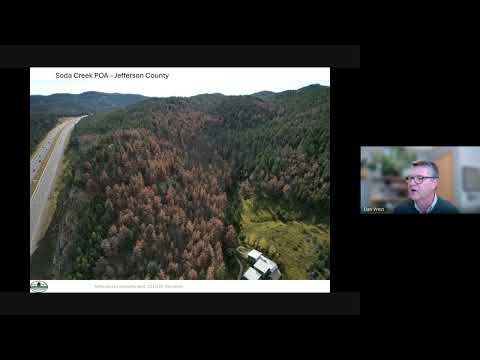
Colorado State Forest Service entomologist Dan West told the Colorado Forest Health Council on Dec. 5 that the mountain pine beetle outbreak is moving into lower‑elevation ponderosa pine stands along the Front Range and that managers are seeing an uptick in visible infestations along corridors such as I‑70.
"We are seeing some increase in mountain pine beetle activity along the Front Range," West said during a presentation to the council. He summarized historical outbreaks (dating to 1996) and said roughly 4.1 million acres of pine forest exist in Colorado, with a recent red‑tree footprint concentrated west of Denver and south toward Park, Jefferson and Clear Creek counties.
Why it matters: West said bark beetles preferentially attack the largest‑diameter trees because they provide more phloem for reproduction, and that stands with basal area above roughly 75–80 square feet are showing the most activity. "They're choosing those largest diameter trees first because the food source is greater on those larger diameter trees," he said. That pattern, combined with several years of below‑average precipitation, has produced "dry attack" in which trees lack the resin to resist beetle attacks.
Council members pressed staff on operational and policy barriers. West and other state staff identified three near‑term constraints: a shortage of public outreach and owner education about timing and treatment methods; limited sort‑yard and processing capacity for "hot" (infested) wood; and waning or expiring legislative incentives for using blue‑stain wood.
"A landowner spent more than $100,000 to treat his land, but they did the work in July and August — right when the beetles are flying — and every single residual tree was infested," West said, using the example to stress the need for timely work guided by certified foresters.
On treatments, West recommended active removal and processing as soon as beetle flight ends: properly sized chipping and debarking disrupt beetle life stages. "Most recommendations say 1 inch by 1 inch" for chip size to render phloem nonviable, he said. He advised doing work in fall and winter when possible and using semiochemicals such as verbenone to protect residual trees if work must occur in spring.
West also described acceptable thermal treatments: a lethal threshold near 120'0F for insects and composting at about 155'0F for sufficient duration to kill beetles. He cautioned against household solar/plastic treatments in Colorado because wind and thin plastic reduce effectiveness and leave plastic debris on the landscape.
Several council members — including industry representatives and county commissioners — urged the council to focus on infrastructure and market fixes so that needed biomass can be removed and processed without prohibitive freight costs. Mark Morgan noted that blue‑stain wood generally carries a lumber market penalty but can support niche uses; he said legislative or programmatic support should prioritize local, durable markets and infrastructure rather than rely on distant carbon‑credit markets.
The council asked staff to follow up with maps, draft legislative concepts (including whether incentives for blue‑stain wood can be extended) and more detailed answers about sort‑yard capacity. Staff said the governor—s office plans a public announcement and some material remains under a close hold; West and DNR staff said they would share non‑proprietary maps and written follow‑up for the council.
Votes at a glance: The committee approved the prior meeting minutes by voice vote and later adopted a motion to adjourn; no other formal ordinances, appointments or budget votes were taken at this meeting.
What—s next: Council members agreed to hold further deliberations in January and asked several subcommittees (leveraging resources, prescribed fire and infrastructure) to explore funding blends, access for mechanical treatments and regulatory barriers to prescribed burning and pile disposition. Staff also will compile outreach materials and answers to the council—s written questions for distribution before the next meeting.
Sources and attributions: Quotes and factual claims above are drawn verbatim or as close paraphrase from remarks by Dan West (state entomologist, Colorado State Forest Service), Larimer County Commissioner Julia Shab McNally (chair), and other council members during the Dec. 5, 2025 Colorado Forest Health Council Legislative Committee meeting. Some operational details (aerial survey numbers) were described as draft by West and therefore were not reported as final figures.
Ending note: Council members emphasized urgency but also cautioned that the governor—s office would lead public messaging in December; the council paused major legislative decisions pending additional maps, staff follow‑up and a fuller data release.