Caltrans, CTC train applicants on PSR-equivalent requirements for Active Transportation Program
Loading...
Summary
Caltrans and California Transportation Commission staff urged ATP applicants to provide consistent, deliverable PSR-equivalent materials — matching narrative, plans and estimates — and walked through required attachments (engineer checklist, estimate template, 25r/25p forms) and common pitfalls including unrealistic right‑of‑way costs and missing deliverability evidence.
Caltrans and California Transportation Commission staff on Wednesday outlined what they expect applicants to submit as a Project Study Report (PSR) equivalent for the Active Transportation Program (ATP), stressing that clear, engineer‑verified plans and realistic cost and schedule figures are required before infrastructure can be programmed.
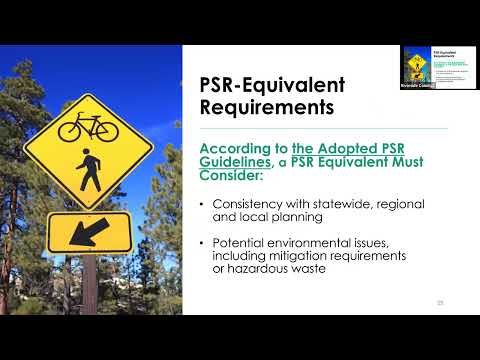
In a workshop that included ATP program managers from Northern, Southern and Central Caltrans districts, presenters said the ATP application itself must serve as the PSR equivalent: the written scope, plans and the project programming request (PPR) together must verify scope, schedule and cost and demonstrate constructability and deliverability. "Your application must be able to verify the scope, the schedule, and the cost estimate clearly," said Teresa McWilliam, ATP program manager, underscoring that reviewers will deduct points where application narratives, plans and cost estimates do not match.
Why it matters: ATP can fund a wide range of active-transportation projects, but Caltrans staff warned that insufficient technical detail has led to cancellations and delays. Teresa McWilliam said the ATP has now seen 1,262 projects, with 515 active and 684 completed; 63 projects were canceled, representing about $136,000,000 in cancelled awards — a result the presenters said stronger PSR-equivalent documentation can help avoid.
What applicants must show: Presenters walked through the engineer's checklist and required attachments. Elijah Hall, ATP manager for the Southern districts, said a California‑registered professional engineer must sign and stamp key documents and that layouts and cross sections must show existing and proposed conditions, right‑of‑way lines, and sufficient detail so an evaluator can understand the full scope. "If you cannot understand the scope from the plan alone, we cannot either," Hall said.
Cirillo, ATP manager for the Central districts, reviewed the required project estimate template and urged applicants to segregate ATP‑eligible items from nonparticipating or ineligible costs, to account for escalation, and to include realistic contingency. He noted some applicants understate right‑of‑way impacts or use only 30% plans to generate high‑confidence cost estimates. "Only certain items can be used as lump sum," Cirillo said; using lump sums for all construction items can reduce review scores.
Non‑infrastructure and plans: Alidar Westbrook, ATP non‑infrastructure and plans manager and project manager for the Active Transportation Resource Center (ATRC), explained that non‑infrastructure (NI) work uses the '25r' spreadsheet to list tasks, deliverables, schedule and costs, and must be specific and sustainable after ATP funding ends. Plans are captured in the '25p' form and must remain a stand‑alone project type; applicants cannot combine plans with other project types.
Common questions: In Q&A, staff said PSR equivalents are acceptable for some other programs (e.g., STIP and some SB1 programs) but noted a baseline agreement or additional documentation may be required at programming. On feasibility studies, staff reiterated that feasibility work alone is not ATP‑eligible because ATP funds programming‑level documents (roughly 30% design); applicants were advised to either package feasibility work into a programming document or seek state‑sponsored PID resources. Anya Allenbacher, an ATP manager at the commission, added that deliverability is used as a tie‑breaker during funding decisions, so projects with cleared environmental and right‑of‑way can move to the top of funding lists.
Practical advice and next steps: Staff repeatedly urged applicants to visit sites in person — "go out and look because, you know, if you're looking at it from Google Earth... then you get out there and realize there's a hill," Teresa McWilliam said — involve maintenance, right‑of‑way and environmental staff early, secure partner commitments before application, and be conservative when estimating counts (for example, list 15 ADA ramps rather than an optimistic 20 if unsure). The presenters announced office hours in January–March for follow‑up questions and said workshop materials and a recording will be posted on the CTC website. The central Cycle 8 workshop is scheduled for December 10 (virtual).