
Caltrans previews $17 billion draft 2026 SHOP; says storm damage and costs push projects across years
Get AI-powered insights, summaries, and transcripts
Subscribe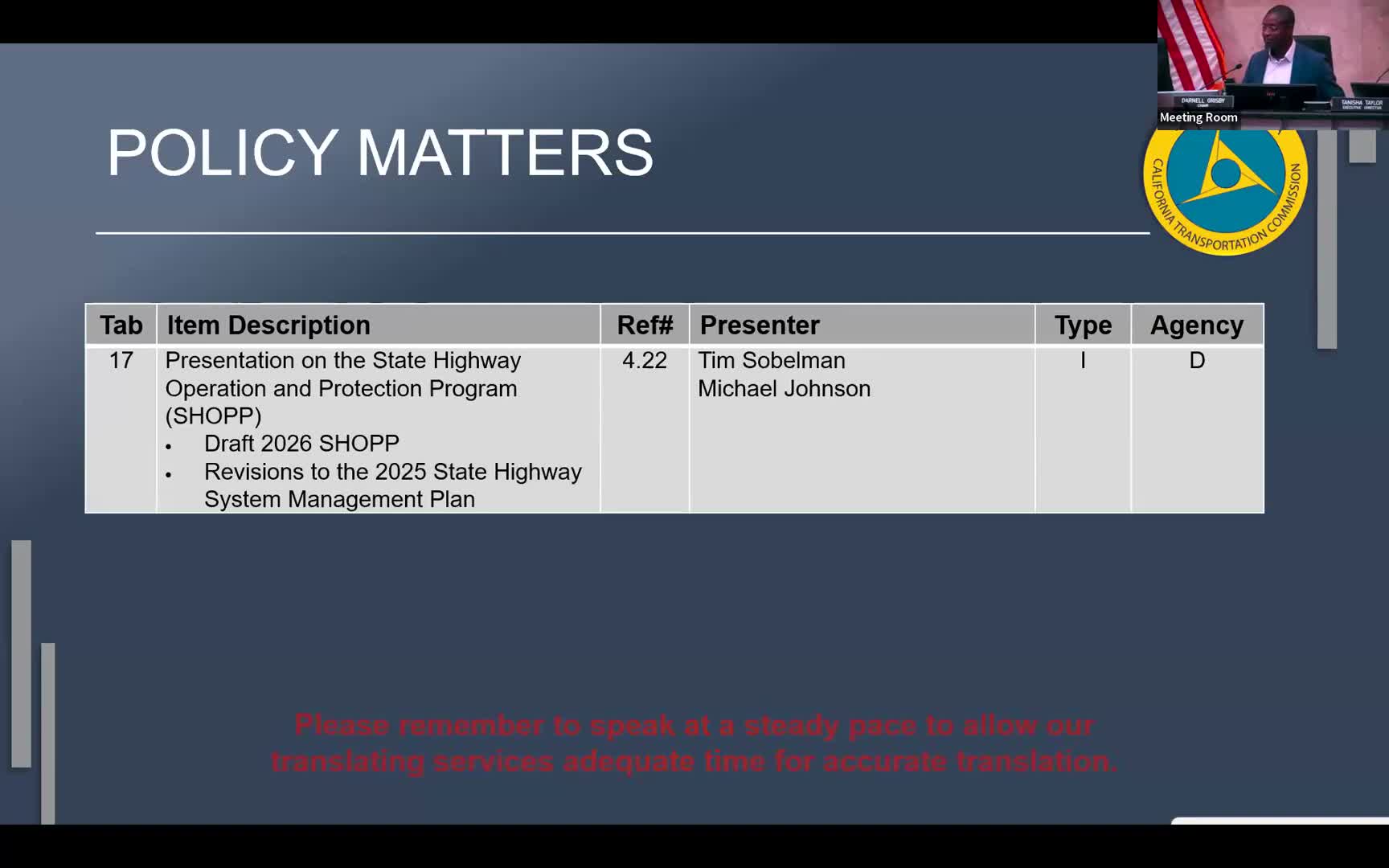
Summary
Caltrans presented the draft 2026 State Highway Operation and Protection (SHOP) program covering roughly 600 projects and $17 billion, saying recent storm and fire damage and rising construction costs will shift some allocations into the next SHOP cycle though projects themselves remain in the pipeline.
Caltrans told the California Transportation Commission that its draft 2026 SHOP will include about 600 projects and roughly $17 billion in construction across the 2026–2030 window, but that persistent storm damage and cost escalation are delaying some allocations into the next SHOP cycle.
Mike Johnson, Caltrans state asset management engineer, described the draft as “a robust SHOP” and said the program still aims to be a “fix‑it‑first” portfolio focused on pavements, bridges and traffic management systems. He summarized the program in blunt terms: “We’re still talking about almost 600 projects. We’re still talking about $17,000,000,000 worth of construction.”
Johnson and Caltrans staff explained that three years of unusually large emergency damage (more than $1 billion a year) and broad price increases have combined to shrink the department’s near‑term allocation capacity. The practical effect, Johnson said, is timing shifts: projects expected to be allocated late in a fiscal year may be pushed into the following SHOP, but “these are the same projects—the money is gonna come out of this year versus next year.” He used a grocery‑store analogy to make the point: “between you filling your cart and you getting to the register… the prices all went up.”
Caltrans emphasized that the asset‑management approach remains intact: project selection and prioritization use district‑level performance targets and a 10‑year ProjectBook dashboard that maps and publishes planned projects. Johnson said the draft preserves investments in pavement rehabilitation, bridge repairs and other performance objectives and expects that performance targets will remain achievable by 2027 despite the timing shifts.
Why it matters: The draft program defines planned investments across the state’s highway system; shifting allocations into later SHOP cycles changes when work reaches construction and when users see benefits, and it affects bidding, contractor scheduling and local partner coordination.
Next steps: The draft 2026 SHOP will be posted for public comment (through mid‑January) with an online, GIS‑enabled dashboard; public hearings will follow in February and a final program is expected to come before the commission for adoption in March.