
Inland Empire residents press state advisory committee to act on truck routes, AB 98 and access to transit
Get AI-powered insights, summaries, and transcripts
Subscribe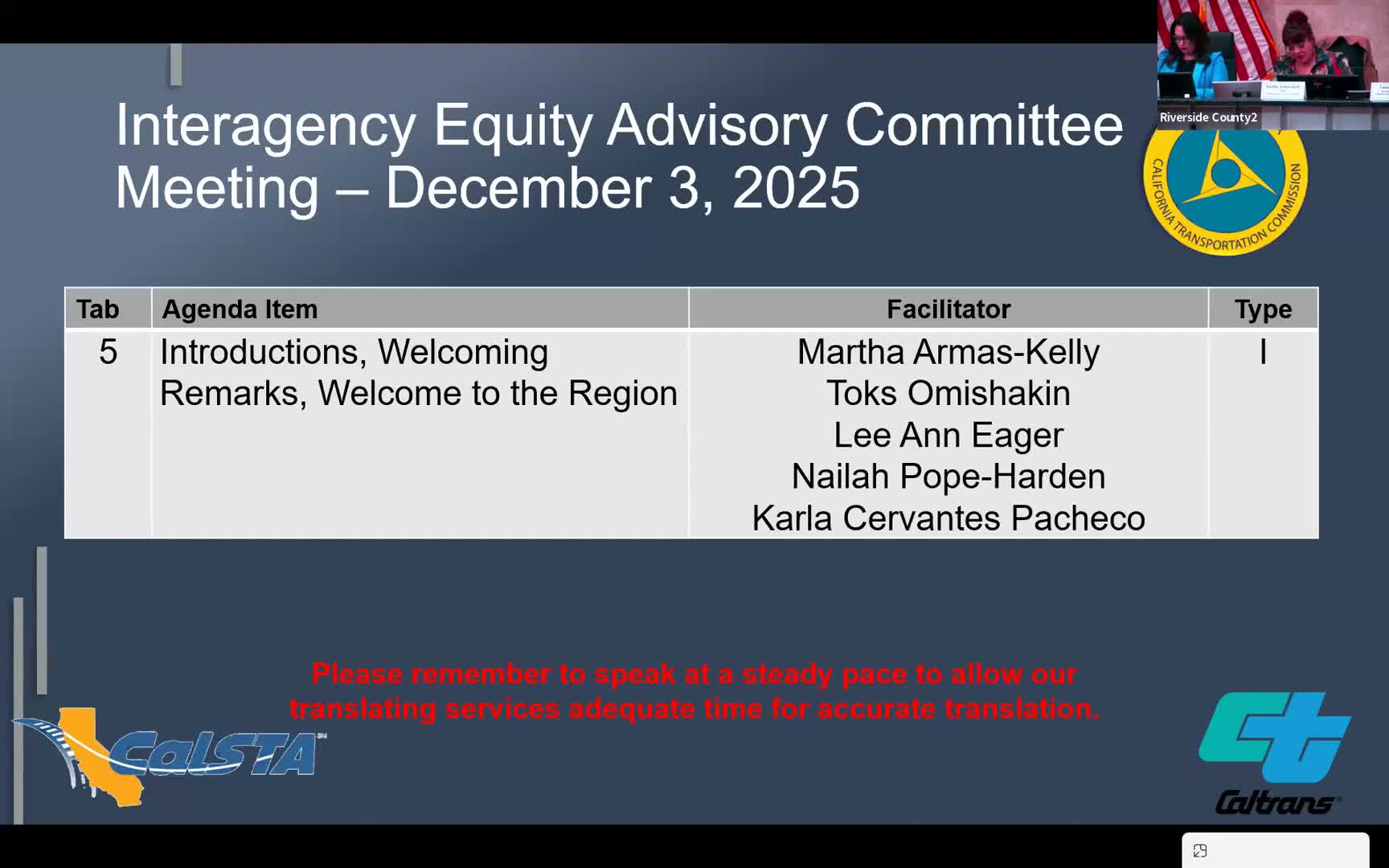
Summary
Community leaders and residents told the Interagency Transportation Equity Advisory Committee in Riverside that decades of warehouse growth and truck traffic have harmed neighborhoods, schools and people with disabilities, and asked Caltrans and local governments to prioritize accessible sidewalks, enforcement of truck routes and meaningful AB 98 outreach ahead of the Jan. 1, 2026 deadline.
RIVERSIDE, Calif. — Dozens of residents and community groups urged state transportation advisers on Dec. 3 to do more to protect neighborhoods in the Inland Empire from the health and safety impacts of rapidly expanding warehouses and truck traffic.
At a meeting of the Interagency Transportation Equity Advisory Committee, community members described congested streets near schools, damaged local roads and bus stops that are inaccessible for residents who use wheelchairs. ‘‘We have more trucks than ever and our freeways are outdated,’’ said Ishmael Gonzalez, a Sierra Club member who told the committee that Moreno Valley alone faces an estimated increase of “about 12,000 trucks” tied to recent plan updates.
The Freight Communities Action Coalition — a coalition of local grassroots groups that received a $250,000 educational grant from the California Air Resources Board — presented a truck-route outreach effort and recounted a Nov. 7 summit attended by more than 50 people. Carla Cervantes Pacheco, coalition cofounder, described the lived experience of a Mead Valley resident, Mauro Avelar, who uses a wheelchair and cannot safely access the nearest bus stop because of dirt approaches and steep slopes.
Carla Cervantes Pacheco said the coalition is preparing community-drawn truck-route maps to share with cities and county planners and asked state officials to help ensure that AB 98's requirements are implemented with early, robust community involvement. "All new warehouses must be on truck routes with limited exceptions starting 01/01/2026," she said, summarizing the bill—s core provision and urging clearer outreach and technical assistance for local jurisdictions.
Committee members and visiting officials acknowledged the problem but said the committee—s role is advisory. Vice Chair Anna Gonzales asked staff to connect with Irma Flores, a property investor who had earlier described violent homeless encampments on a Caltrans easement behind apartment units in San Bernardino; staff said they would make sure the appropriate district and agency contacts were notified.
Several residents said they had not been notified or included in local truck-route workshops. "The outreach has been minimal," Tatiana Flores of Moreno Valley told the committee, saying some community meetings were announced the day before and lacked translation or virtual options. Ishmael Gonzalez reported the state attorney general had written to Moreno Valley about its failure to adequately update outreach and circulation elements in compliance with AB 98.
State and agency officials in the room said they had heard community concerns and outlined several tools intended to help. Caltrans staff described development of district-specific engagement playbooks, an equity index used to help prioritize attention, and a forthcoming director—s policy on community engagement. Caltrans— acting chief deputy director, Dave Moore, said the equity index and the engagement playbook components were shaped in part by the committee—s earlier feedback.
Members of the committee pressed for clarity on how district offices will use playbooks and how local community-based organizations will be networked into project engagement. Caltrans said required district actions include (1) road safety infrastructure plans, (2) district community engagement playbooks, and (3) internal district equity workgroups, and staff said headquarters is developing a community engagement portal to track outreach and make engagement more transparent.
What happens next: the Freight Communities Action Coalition said it will continue to press cities to host community workshops and to share its community-sourced truck-route maps; Caltrans staff said they would present draft engagement tools and playbooks to districts and return to the committee with additional implementation materials.
The committee recorded the public comments and has referred them to the relevant Caltrans district and agency staff for follow-up. The meeting did not produce a formal enforcement action or a regulatory change — the committee makes recommendations to the California Transportation Commission, CalSTA and Caltrans.
Reported authorities: the presenters referenced Assembly Bill 98 and its deadline and the committee and agency staff repeatedly cited related programs and guidance (AB 98, CARB grant for education, Caltrans equity index) as the legal and programmatic frame for local implementation.