CTC subcommittee reviews AB 251 task-force findings on vehicle weight; members press for clearer, local guidance
Loading...
Summary
The California Transportation Commission’s Transportation Planning Subcommittee received UC Berkeley–informed task-force findings required by AB 251 on vehicle weight, injury trends and fee options; members asked for clearer, actionable recommendations and flagged equity, rural impacts and infrastructure concerns. The subcommittee approved November minutes.
The Transportation Planning Subcommittee of the California Transportation Commission heard an informational presentation on the Vehicle Weight Safety Study mandated by Assembly Bill 251 and discussed the task force’s findings, equity concerns and potential fee structures.
Kyla McDonald, associate deputy director for legislation and finance at the California Transportation Commission, told members the task force—supported by research from the University of California, Berkeley—could not identify a single causal relationship between passenger-vehicle weight and statewide fatality or serious-injury trends: “a causal relationship between vehicle weight and fatality and serious injury trends could not be identified,” McDonald said. She noted, however, that research shows parallel trends (increasing average vehicle weight and rising vulnerable-road-user fatalities) and that the task force discussed other contributing factors including speed, vehicle form factor, road-user behavior and vehicle age.
The presentation included statistics from the academic research: examples cited included a 71 percent increase in pedestrian fatalities and an illustrative finding that “children pedestrians are 82 percent more likely to be killed if struck by an SUV versus a sedan.” McDonald emphasized those figures are drawn from the UC Berkeley analysis and task force discussions; she said the forthcoming draft legislative report will incorporate the academic evidence, task-force feedback and Commission input.
Members pressed staff for clearer, actionable guidance for the Legislature. Peggy Martinez asked what the Commission hopes to gain from the legislative report and whether stakeholder input—such as from the National Federation of the Blind of California—had been considered. McDonald said the federation’s feedback focused on ensuring the built environment is accessible for people with vision impairment and that the staff will incorporate stakeholder perspectives in drafting recommendations.
Member Michelle Rousey urged the staff to present specific, implementable requests that account for equity concerns for seniors and low-income residents. Member Lisa Marie Alvarado and other members asked that the report include tools or guidance useful for local jurisdictions and noted that some localized crash data show rural roads may bear a disproportionate share of fatalities.
Members also discussed alternatives to fees and technical responses. Member Howard Wong recommended analyzing vehicle design and safety technology used abroad and said the data should be easy to understand for policymakers. Staff noted that some countries require pedestrian-collision testing and that the National Highway Traffic Safety Administration has signaled rulemaking on pedestrian protection in coming years.
On fee design, McDonald summarized task-force modeling: a one-time point-of-sale weight fee produces a larger modeled change in consumer purchases of the heaviest vehicles than a smaller annual fee, and exemptions would reduce projected revenue; task-force members were sharply divided, citing political feasibility and affordability.
Members raised region-specific concerns. Chair Anna Gonzalez and others highlighted heavy commercial-vehicle impacts in the Inland Empire, illegal overweight loads from ports, the need to coordinate with Safe Routes to School programs, and the risk of displacement when investing in infrastructure in disadvantaged neighborhoods. Staff said those concerns appear in the task-force findings and will be considered in the draft report.
No members of the public requested comment. The subcommittee then considered noncontroversial business: Member Gloria Huerta moved to approve the November meeting minutes; the motion was seconded and, after a roll-call vote, the motion carried and the minutes were approved. The panel adjourned and will reconvene in January to continue advisory work on Caltrans' transit policy implementation plan and the California freight and mobility plan.
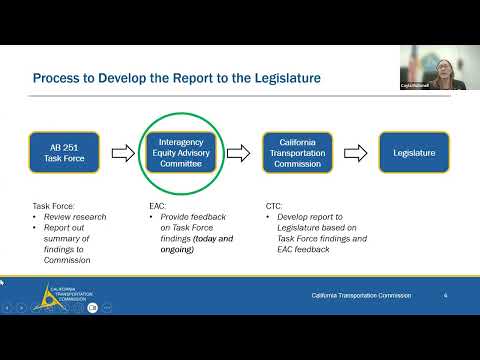
The Commission staff intends to use the feedback from today’s meeting, UC Berkeley’s report and the task-force findings to draft a report to the Legislature in early 2026 and to seek further public comment at a workshop before presenting a final report to the Commission for adoption.