
Michigan Supreme Court hears dispute over whether plea to possession limits OV15 trafficking score in People v. Walker
Get AI-powered insights, summaries, and transcripts
Subscribe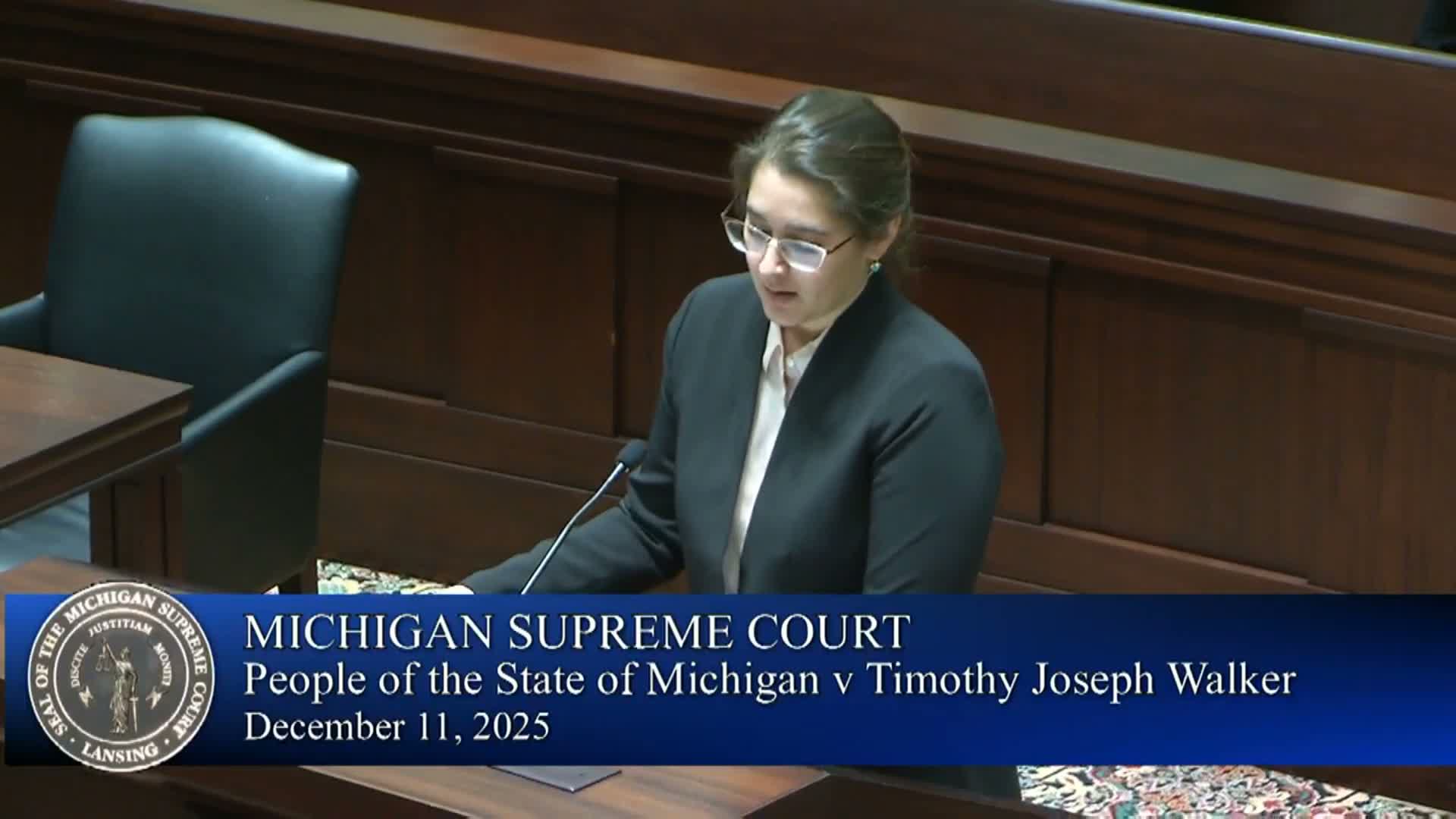
Summary
In People v. Walker, defense counsel argued a plea to simple possession and a limited factual basis should prevent scoring five points under OV15 for trafficking; an amicus prosecutor argued the sentencing record (scales, packaging, cash) supports OV15 scoring. The court submitted the case for decision.
The Supreme Court heard oral argument in People v. Walker over whether a guilty plea to simple possession, with a stipulated factual basis, limits the sentencing court from scoring five points under offense-variable OV15 for conduct indicating trafficking.
Miss Lawton, defense counsel for Timothy Walker, told the court the core question is "how a plea agreement defines the sentencing offense when calculating an offense-specific variable like OV15." She said Walker pleaded guilty to simple possession and that the parties stipulated to a factual basis describing possession of 23 grams of methamphetamine. "That sentencing offense of simple possession as outlined by the party's agreement and Mr. Walker's plea does not support scoring OV15 for delivery, for possession with intent to deliver, or for trafficking," she said, and argued Walker "is entitled to resentencing."
John Boitalla, an assistant Wayne County prosecutor appearing for the Prosecuting Attorneys Association of Michigan as amicus, urged a different reading. He told the court that at the time Walker possessed the methamphetamine, "he was also in possession of digital scales, ziplocks, $600 in money" and that the record included the prosecutor's representation that Walker had a supplier and sold on a continuing basis — facts the amicus said a sentencing judge could consider when scoring OV15. "Those are the facts of the sentencing offense," Boitalla said, arguing it was not error for the trial court to score five points in this case.
Justices asked whether precedents such as Jackson, McGraw and Morrison require limiting OV15 to the elements of the conviction or allow consideration of attendant circumstances described in the presentence investigation report (PSIR) or a stipulation to the police report. Miss Lawton said the plea colloquy and the factual basis for the plea should be the starting point for determining the "sentencing offense," and that dismissed conduct (here, intent to deliver) carries weight and should not be treated as part of the sentencing offense unless expressly included in the factual basis. She cited unpublished court of appeals authority (People v. Thomas, docket no. 311569, 2013) to support the position that dismissing intent to deliver removes that conduct from the sentencing-offense analysis unless the factual basis incorporates it.
Boitalla acknowledged hypothetical "fictional" pleas might present harder questions but maintained that a fact-intensive inquiry is appropriate and that, on the record before the sentencing court in Walker's case, there was sufficient evidence to score OV15. He emphasized the statutory language in MCL 777.451(h) directing courts to consider "circumstances" of the crime and argued that, particularly in possession cases, those circumstances can encompass indicia of trafficking.
Counsel also discussed whether the decision in Hines (and related appellate briefing) affects remand and resentencing; Miss Lawton argued Walker was on direct appeal when Hines was decided and that Hines supports her request for resentencing.
The justices thanked counsel and submitted the case for decision.
The court did not announce a ruling at the argument; the matter was submitted for consideration and decision.