Get Full Government Meeting Transcripts, Videos, & Alerts Forever!
Get email alerts on the Broadband Utilities topic
No spam. Unsubscribe anytime.
Committee hears BEAD-broadband update and county limits on utilities authority
Summary
County officials said federal and state programs are driving broadband expansion in Ashland County—with Norvado, Bug Tussle and Bayfield Wireless named as providers—while several members stressed that permitting and major utility decisions lie with state agencies, limiting direct county control.
Dan Grady updated the committee on broadband and utilities, saying federal BEAD-related work is in motion and the state Public Service Commission managed the procurement. “Norvado is gonna be doing a lot of broadband in part of the county,” he said, and committee members named Bug Tussle and Bayfield Wireless as other expected providers.
Grady told members the federal and state frameworks have constrained local influence: “The county any county input was taken out of it by the Trump administration,” he said during the discussion, offering that the state Public Service Commission and related agencies handle bids and implementation. He also stressed limits on county authority over major infrastructure: permitting for operations such as large generation projects, transmission lines or major cellular permits typically passes through state agencies (the Public Service Commission, DNR and DSPS, as discussed in the meeting).
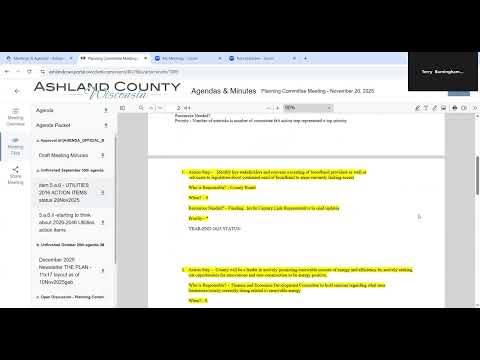
Committee members raised utility-related action items from the 2016 plan—broadband stakeholder convening, renewable-energy goals for county facilities and private on-site wastewater item follow-ups—and asked staff to check which items were completed and which remain outstanding. Dan warned that local capacity for a large data center is limited: “Xcel Energy doesn't have enough electricity to supply a data center,” he said, adding it could take years to deliver additional transmission capacity.
Members framed possible local responses that fit within legal limits, such as targeted noise or land-use ordinances for very large facilities, while acknowledging such local rules could face legal challenges. The committee asked staff to gather updated information so subcommittees can recommend measurable objectives for the utilities element of the comprehensive plan.
The committee referenced federal and state programs by the names used in the meeting (BEAD program, Public Service Commission, DSPS, DNR) and described them as the authorities guiding deployment and permitting.