DNR: Northern elk herd ~367 and rising; county briefed on relocation, lure crops and adaptive management
Loading...
Summary
DNR wildlife biologist Josh Beagle told the Ashland County Land Conservation Committee the northern elk population is about 367 animals and growing roughly 5–8% annually, and outlined tools — relocation, lure crops and targeted hunting quotas — the state uses to reduce agricultural damage while supporting recreation and habitat goals.
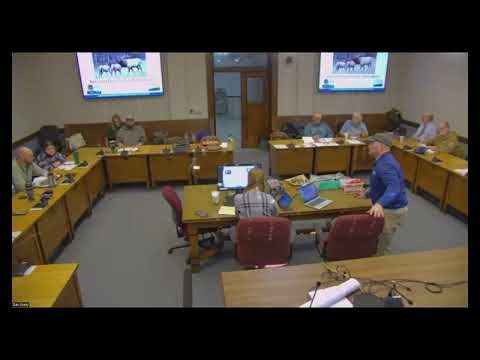
The Ashland County Land Conservation Committee heard a detailed presentation from Josh Beagle, DNR wildlife biologist, on the status and management of the northern Wisconsin elk population.
Beagle said the department’s latest minimum count for the northern management zone is about 367 animals across Ashland, Bayfield, Price, Rusk and Sawyer counties and that the population has been increasing at roughly 5–8% per year. “Our goal is to operate the elk herd with a minimal amount of negative conflict,” Beagle said, describing the new statewide elk management plan approved in August 2024.
The department reviewed reintroduction history and genetics: early efforts traced to releases from Michigan and Yellowstone, and a 2012 Natural Resources Board amendment allowed importing animals from Kentucky to boost genetic diversity. Beagle described 2019 releases and follow-up translocations; some animals were lost after release and one animal was euthanized during testing in the quarantine period, a decision Beagle said was made to protect herd health.
Local population structure and access were central to the committee’s concerns. Beagle gave minimum counts by subgroup: the Butternut group (about 18 adults plus calves), a Glidden group that ranges historically from 15–30, and a larger “hybrid” group estimated at a minimum of 35 animals and possibly as many as 45–48 at times of year. He noted that much of the elk range is on private land, which limits hunter access and concentrates mature bulls on private holdings.
Agricultural damage and abatement were the most detailed parts of the presentation. Beagle cited a local case—producer John Radner—whose damage claims were about $7,100 in 2022, reached the program cap of $10,000 in 2023, and fell to roughly $3,000 in 2024 after a lure-crop pilot. The department has tested lure crops (planting 24–25 acres of mixed forage to draw elk away from fields), used baited corral traps and relocated animals; on March 7 in a recent operation the department relocated 12 elk to reduce local pressure.
Beagle described the full suite of abatement tools: hazing, repellents, temporary and permanent fencing, placement of lure crops, aerial spraying (with caution because of cost–benefit concerns), capture and relocation, and a narrowly defined shooting-permit process the department intends to use only as a last resort. He said capture-related mortality in their program is very low (long-term capture mortality near 0.05%).
On monitoring, Beagle said the department uses GPS collars (about 120 collars deployed in the region), aerial and thermal surveys, and a calf survival study that uses vaginal implant transmitters to locate births and assess early calf survival.
The DNR also described changes in management strategy: rather than a single fixed statewide numerical target, the new plan uses an adaptive table keyed to elk density and social acceptance. In the northern zone the benchmark figure cited was about 650 animals; the Elk Advisory Committee will meet next week to review the table and set quotas and unit-specific tag recommendations.
Committee members asked about wolves, disease risk and tourism-related economic benefits. Beagle said current comparisons of collared wolves and collared elk do not show wolf packs intentionally following elk, that the department conducts disease testing through the Wisconsin Veterinary Diagnostic Laboratory and maintains biosecurity for translocations, and that economic impact studies of viewing and hunting are on the department’s research agenda but not yet complete.
Next steps: the DNR will continue monitoring and present quota recommendations through the Elk Advisory Committee process; local mitigation work (lure crops, enrollment in damage programs and targeted relocations) will continue subject to funding and landowner participation.