Get Full Government Meeting Transcripts, Videos, & Alerts Forever!
Get email alerts on the Billboards topic
No spam. Unsubscribe anytime.
Board approves two billboard conversions to digital, citing buffering and lighting studies
Summary
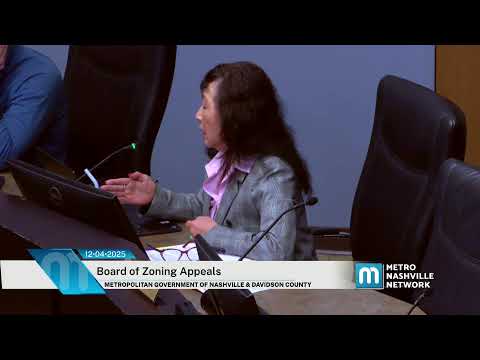
The Metro Nashville Board of Zoning Appeals on Dec. 4 approved two requests to convert existing interstate-facing billboards to digital faces after applicants presented light studies and mitigation plans; commissioners attached standard conditions in one case and split 4–1 on another where planning staff had recommended denial.
The Metro Nashville Board of Zoning Appeals on Dec. 4 approved two variances allowing existing interstate-facing billboards to be converted to digital displays, after hearing presentations about sightlines, illumination and neighborhood buffering.
At a rehearing on case 2025-88, attorneys for Lamar Advertising told the board the added digital face would serve Interstate 40 traffic and not nearby Elm Hill Pike residences because of intervening buildings and mature trees. John Michael of Thompson Burton said the sign would sit about 390 feet from Elm Hill Pike and that the company could accept a nondigital alternative if the board was unwilling to permit a digital face. The board voted 5–0 to grant the variance after concluding the site’s configuration and screening met the ordinance’s intent to protect residential areas from illumination.
Later in the meeting, OutFront Media sought a variance to convert a center, V-shaped billboard on a parcel zoned SP to digital faces (case 2025-122). John Cooper of Holland & Knight said the SP was adopted in 2011, before the current generation of digital signage, and that a site-specific light study found negligible illumination reaching nearby residential lots, which are heavily wooded and about 550 feet from the sign. Planning staff recommended denial, citing potential light impacts to the single-family neighborhood across I‑40; commissioners pressed the applicant on distance measurements and possible mitigation such as baffles or directional shielding. The board approved the variance 4–1.
Both applicants submitted light studies and committed to meet Metro standards for brightness, automatic dimming and message dwell time. In the Lamar presentation, Michael cited Metro Code 17.320.05 and Tennessee Code Annotated provisions for variance hardship, arguing extraordinary site conditions and technological changes supported relief. OutFront’s counsel noted the SP’s regulatory nature and said converting to digital would not create new visibility for residences given existing screening.
Planning staff recommendations and objections were entered into the record for both cases. Commissioners said the frequency of digital-sign appeals indicates the zoning code’s sign provisions may need updating to reflect modern technology. No board member proposed amending conditions beyond technical compliance, but one commissioner asked staff to consider ordinance changes to avoid similar rehearings in the future.
The two decisions were procedural variances tied to evidence in each file: the Lamar motion passed unanimously, and the OutFront Media motion passed 4–1. The board did not impose additional monetary penalties or operational restrictions beyond the code-compliance requirements discussed at the hearing.
The board’s approvals are final unless appealed under the city’s appeals process. Applicants were instructed to follow up with the planning and codes departments on next steps and permitting.