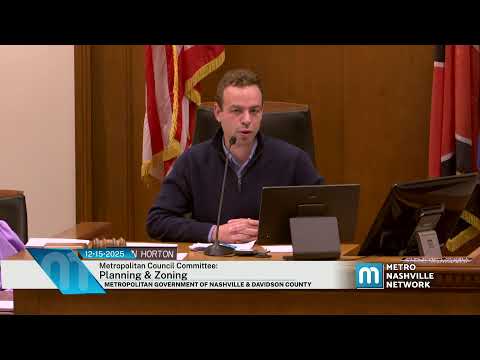
Committee advances zoning changes that limit home heights in many single- and two-family zones after heated debate
Loading...
Summary
After extended debate and multiple amendments, the Planning & Zoning Committee recommended approval of BL 2025-1006 to amend Title 17 height rules for RS and single-family zones, adding exemptions for the downtown core and review requirements; committee votes varied across amendments before approving the bill as amended.
The Metro Nashville Planning & Zoning Committee on Monday advanced major changes to zoning rules that constrain building height in a range of single-family and two-family residential districts.
Sponsor Councilmember Gamble framed BL 2025-1006 as one of four housing bills developed over six months to address neighborhood concerns about three-story dwellings in predominantly single-family areas. The ordinance amends chapters 17.04, 17.12 and 17.16 of the Metropolitan Code to set new height limits in RS and single-family zoning and to simplify conditions for permitting two-family dwellings in multiple zoning districts.
Public commenters warned of unintended consequences. Elliot Perry (District 21) said the bill’s height caps could eliminate many missing-middle housing types on small lots, raise per-unit costs and retroactively undermine owners’ development expectations. Brian Newman, a downtown resident and worker, urged an exemption for the downtown loop, saying height is essential downtown for walkability, transit and housing supply.
Committee amendments produced split votes. Amendment 1 (housekeeping clarifications on footprint and half-story definitions) passed unanimously. Amendment 4 — requiring a return in early 2027 to assess metrics and infrastructure costs — passed 10-1. An amendment from Councilmember Coopin to delay the bill’s effective date to May 31, 2026 failed in committee (final corrected tally 3-8). Amendment 6, which would have raised the proposed maximum to 38 feet and added conditional bonus height, failed (2-6 with two not voting). Amendment 3, exempting the urban core inside the interstate loop, was later recommended for approval 10-0 and incorporated.
Debate touched on aesthetic concerns, life-safety and legal risk. Councilmember Parker cautioned about life-safety implications and differences between single-family and multifamily building codes; Councilmember Welsh warned of increased costs and potential legal liability for the city. Sponsor Gamble and supporters said the changes are targeted to R and RS zones outside the downtown core and intend to preserve neighborhood context while offering other avenues for housing.
After the sequence of amendments, the committee recommended approval of BL 2025-1006 as amended (recommendation tally reported as 10 in favor, 0 against). The recommendation moves the ordinance to the full council for final consideration where members indicated they may propose additional floor amendments.
Key technical points from the hearing: the planning office confirmed existing issued permits remain governed by prior regulations (grandfathering), while the proposed rules would limit future development in the affected zoning categories. The sponsor repeatedly emphasized the limited geographic scope (not applying to higher-density zones) and the goal of encouraging contextual development.