Get Full Government Meeting Transcripts, Videos, & Alerts Forever!
Get email alerts on the Ethics Complaints topic
No spam. Unsubscribe anytime.
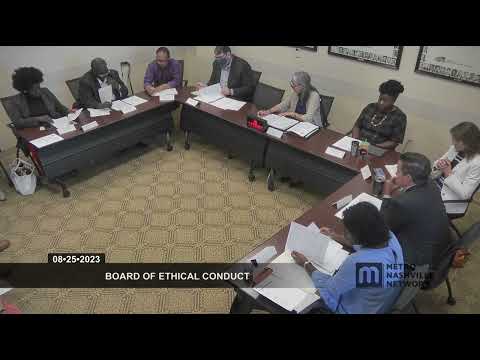
Ethics board adopts public‑comment rules and dismisses two complaints after legal review
Summary
The Metropolitan Board of Ethical Conduct voted to adopt advance and door sign‑up for public comment with a two‑minute limit, and dismissed two recent complaints — one about alleged discriminatory remarks at a benefit board meeting and one alleging improper influence on a stadium vote — after the Department of Law advised the allegations fell outside the board’s ethical standards.
The Metropolitan Board of Ethical Conduct on Aug. 25 voted to adopt a public‑comment procedure that allows both advance sign‑up by email to the metro clerk and sign‑up at the meeting door, and limits speaking to two minutes per person.
The board’s action followed a motion to adopt the clerk‑office sign‑up process and the two‑minute time limit for speakers; members approved the motion by roll call (6 in favor). The adopted procedure also makes clear that comments will not be accepted after the designated public‑comment period for that meeting has closed.
Why it matters: the board said the change implements requirements in Public Chapter Number 300 (effective 07/01/2023) while balancing access and order. Members said the email sign‑up will be handled by the metro clerk’s office so the clerk can add advance signatories to the agenda and track arrivals.
The board also considered and dismissed two separate complaints after receiving written legal memoranda from the Department of Law.
On a complaint arising from a June benefit‑board meeting, the Department of Law summarized its review, saying in part that “the speech described in the complaint does not involve ethical matters” and that, while the comments may be offensive or discriminatory, they concern policy debate and therefore do not automatically trigger the board’s standards of conduct. The board debated whether the alleged comments — which several speakers described in the meeting as morally troubling — fit specific code provisions (including subparts referenced in the memo). After discussion, the board moved to adopt the law department’s recommendation and dismissed the complaint; the roll call recorded six votes in favor and one abstention. The board said it will issue a written dismissal order to the parties.
Separately, the board reviewed a complaint alleging that 13 Metro Council members violated ethical standards by voting for the new Titans stadium after receiving campaign contributions from Titans lobbyists. The Department of Law told the board that political campaign contributions that are received and reported under state law generally are not treated as a disqualifying “thing of value” under the standards of conduct and that the complaint did not allege facts showing a quid pro quo. After deliberation the board voted to adopt the Department of Law’s recommendation and dismissed that complaint as well (roll call showed six in favor; one member did not register a yes vote). The chair said a written dismissal will be published and provided to the parties.
Representative quotes and positions: a board member said of the benefit‑board allegations, “just because it may be legal doesn't make it right,” reflecting a moral concern raised by several members and public speakers. Reverend Lewis urged the board to consider the civil‑rights impact, saying in part, “it's critical that we understand that to certain groups of people, certain things can impact them … for the rest of their lives.” The Department of Law’s representative cautioned the board that its jurisdiction is narrowly focused on the code’s standards for disclosure, conflicts and improper influence and that offensive policy speech can still be protected under the First Amendment.
What the board decided next: for each dismissed complaint the board directed the Department of Law to prepare and send a written order to the complainant and the respondents. Board members noted that dismissal does not bar a new complaint if additional factual allegations are later submitted.
The meeting adjourned after the board moved to the next agenda items.