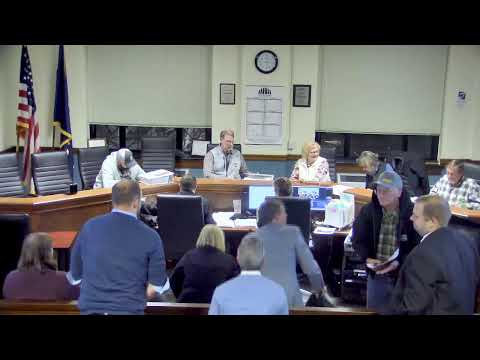
Vermillion County BZA approves Brewlette Creek solar project with conditions and a height variance
Loading...
Summary
The Vermillion County Board of Zoning Appeals voted to approve a special-exception permit and a variance to exceed a 50-foot equipment height limit for the Brewlette Creek solar project proposed by Apex Clean Energy, attaching conditions on road repairs, drainage agreements, technical review and construction timing.
The Vermillion County Board of Zoning Appeals voted to approve Apex Clean Energy’s special-exception application for a utility-scale solar project known in the record as Brewlette Creek Solar and to grant a variance allowing certain substation equipment to exceed the 50-foot height limit. The board attached a set of conditions before final approval, including binding agreements on road use and repair, drainage and soil-and-water approvals, and a requirement that completed construction drawings be reviewed by the county’s engineering reviewer before construction begins.
The board reopened public comment on the petition (petition no. 25-07) for a proposed 200-megawatt solar facility sited on roughly 2,913 acres in southern township. Public comments were mixed. Opponents warned of landscape and long-term agricultural impacts and questioned property-value and supply-chain implications. Proponents — including a letter read on behalf of the Vermillion County Council — argued the project will boost county revenue and create local construction jobs.
During public comment, resident Chris Bate said he was “a 100% against it,” arguing the panels and battery systems will harm farming and local character. Another resident, identified in the record as Tom, raised concerns about property-value effects and singled out studies with foreign authors; he urged the board not to support the project. By contrast, Ashley James read a signed letter from the Vermillion County Council and the auditor stating council support and describing the project as a long-term economic opportunity for the county.
Apex representatives addressed technical and outreach questions. Nathan McClellan, who led the company’s neighbor-outreach effort, described door‑to‑door contacts, mapping updates and 22 signed good-neighbor agreements (18 of which he said include occupied homes). Company counsel Gerald Hasson disputed characterizations of the consultant Aegis’s review as finding substantive defects, saying the Aegis letter reviewed only plan sheets and that additional detail appears in the permit application appendix. Hasson told the board, “I would respectfully disagree with any characterization with the EGIS review that suggests they found any problems,” and invited the board to consider Apex’s written responses.
Board members read five required UDO findings of fact in public and voted on each. Among the findings the board adopted were consistency with the county comprehensive plan and UDO, the project’s asserted lack of public‑health hazards given the applicant’s emergency-action plan, and an analysis concluding no clear negative effect on adjacent property values after the applicant’s review. One board member recorded a dissent on a single finding during the deliberations, but the package — findings plus conditions — ultimately passed.
The board also granted a development-standards variance to allow grid‑interface equipment and substation structures to exceed the 50‑foot height limit (the applicant cited necessary clearances under the National Electrical Safety Code). Board members discussed that the taller structures serve safety and technical functions and that the project’s substation must interconnect with existing transmission infrastructure. A motion to approve the variance was made, seconded and carried.
Conditions the board listed on final approval included: a binding road‑use and repair agreement with the Vermillion County Commissioners; a binding agreement or approval from the Vermillion County Drainage Board and the county Soil and Water Conservation authorities; targeted additional setback or a signed good‑neighbor agreement for at least one nonparticipating dwelling identified on the map; submission of completed construction drawings for review by the county‑contracted engineering reviewer (Aegis) at least one month before construction; and a requirement that construction begin within two years of approval or the applicant must reapply. The board also discussed but did not impose restrictions on future sale or transfer of the project; legal counsel noted a special exception generally runs with the land once issued.
Apex told the board its current schedule targets construction start in early 2027 and grid operation in 2028, and said 167 megawatts of the project’s output have been contracted (leaving roughly 33 megawatts to be sold). Labor representatives said comparable nearby projects employed several hundred workers during construction.
The board concluded the meeting by signing the findings documents and adjourning. The approval is procedural: affected county departments and any required permitting agencies still must complete their respective reviews before construction can start.
Notes on name variants: the project name appears with multiple spellings in the transcript (Brulette/Berulets/Brewlette/Brulettes Creek Solar). This article uses the form Brewlette Creek Solar when referring to the project and identifies the applicant as Apex Clean Energy, as that company name is consistently used in the record.
What happens next: the conditions require intergovernmental agreements and final technical reviews before permits are issued. The permit timeline described by the applicant would put potential construction start in 2027 and operations in 2028, subject to the county and other agencies’ further reviews and any changes in contracts or design.