
Vermillion County commissioners table Wabash Valley Resources community benefits agreement after hours of public opposition
Get AI-powered insights, summaries, and transcripts
Subscribe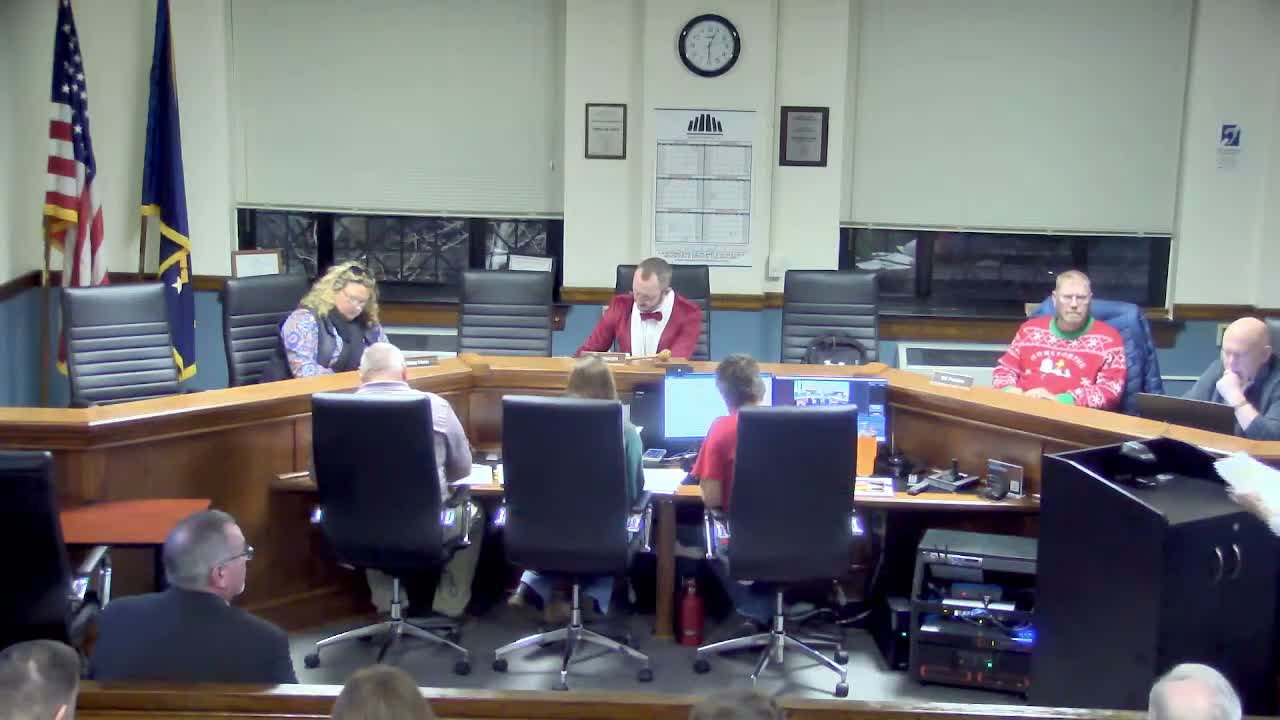
Summary
After a lengthy public-comment period during which dozens of residents urged the board to reject the Wabash Valley Resources community benefits agreement, Vermillion County commissioners voted unanimously to table the agreement for further review rather than sign it on Dec. 30, 2025.
Vermillion County commissioners on Dec. 30 voted to table a proposed community benefits agreement (CBA) with Wabash Valley Resources (WVR) after more than an hour of public comment in which residents raised safety, environmental and legal concerns.
The motion to table — made by a commissioner and seconded — passed by unanimous voice vote. The item will return to the board for further review and possible outside legal and technical analysis before any signature, the commissioners said.
Why it matters: dozens of residents who live near the proposed WVR project told the board the two-page agreement is too vague, contains clauses that could limit the county’s ability to restrict construction or operation, and offers inadequate compensation. ‘‘Everything in here, they’re taking away from you,’’ said public commenter Susan Strelkos, reading from the draft. ‘‘If you sign this, you’re taking away that right.’’
What residents said: speakers repeatedly criticized the CBA’s language on assignment and "further assurances," saying those clauses could bind the county to allow construction or operations without additional county approval. Whitney Boyce said the document ‘‘doesn’t seem like anything that’s tailored to Vermillion County’’ and highlighted a clause she read aloud that, she said, commits the county to steps to ensure the project ‘‘may proceed without impediment.’’
Several speakers also questioned the monetary offer. Doug Martin, Universal town-board president, and others described $7,000,000 as insufficient given projected road impacts and emergency-response needs; one commenter contrasted that amount with local construction costs and called it ‘‘couch change.’’ Amy McClennan, who said she works on multimillion-dollar renovations, described the amount as ‘‘insulting’’ given potential long-term environmental and public-safety risks.
Technical and safety concerns were frequent. Speakers warned about trucking routes, increased heavy-vehicle traffic, and possible effects on nearby Van Dyne Elementary School; one resident warned that surge tanks holding pressurized CO2 would create catastrophic risk if they ruptured. Clayton asked the board to demand proof that WVR had secured the statutorily required 60% landowner consent before discussing the agreement further.
County response and next steps: board members acknowledged the public’s concerns during discussion and said they want additional time to analyze the agreement’s provisions. Commissioners also asked staff to seek outside review of the contract terms and to bring the CBA back with recommended revisions and clarifications. The board’s formal motion to table the item explicitly postponed any signature or final action that night.
What the CBA would do as drafted: residents and several speakers said the draft contains payment schedules and condition-based disbursements, road‑use language and training obligations that, in their view, shift responsibilities for safety and infrastructure onto the county. Multiple public speakers urged that any company‑provided training or equipment be provided directly by the company rather than funded by county funds. Scott Noble suggested placing funds into an escrow account or requiring up‑front payment to ensure money would be available.
Voices for caution and oversight: former commissioner and state representative Tim Yoakam urged the county to demand that the developer provide safety infrastructure directly and warned that accepting funds may create liability for the county. He offered to work at the state level and said he was preparing legislation related to the issue.
What was not decided: the board did not approve or reject the CBA; it voted to table it. Commissioners instructed staff to obtain additional legal and technical review and to collect information public speakers requested (for example, on WVR’s landowner consent numbers and on what attachments or plans the company may refer to in the agreement).
The meeting: the public comment period that preceded the vote included many residents and lasted more than an hour; the board then returned to its agenda and took other routine actions. The community benefits agreement item remains under review and may be brought back for further public discussion and a future vote.
Ending: the board’s action to table leaves the draft CBA open for revision and further review; the commissioners said they will consider outside expert review and the community’s written input before making any final decision.