Get Full Government Meeting Transcripts, Videos, & Alerts Forever!
Get email alerts on the Data Centers topic
No spam. Unsubscribe anytime.
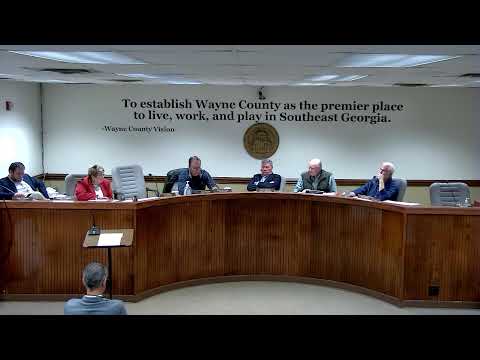
Wayne County reviews draft data‑center ordinance, debates buffers, water and noise limits
Summary
Commissioners reviewed a draft data‑center ordinance that would require state review for very large facilities, set buffers from homes and sensitive sites, and add standards for water use, noise and emergency response; staff will refine language for the January meeting.
Wayne County commissioners spent the meeting reviewing a draft ordinance intended to guide where and how data centers could locate in the county, with debate focusing on setbacks from homes and schools, water‑use verification and noise and fire‑response standards.
The draft would trigger state‑level review for very large facilities — described in the draft as Development of Regional Impact (DRI) projects exceeding 300,000 square feet in urban or suburban areas or 500,000 square feet in rural areas — and references coordination with the Coastal Georgia Regional Development Center. "Once you get ... 500,000 square feet or larger building ... it has to go through what would be ours is the Coastal Georgia Regional Development Center," said Speaker 3, a county official who led the ordinance review.
Why it matters: commissioners said they have no immediate data‑center applications but want a clear local standard so the county can respond consistently if companies inquire. Speaker 3 told the board that other jurisdictions’ experience drove several provisions: "the data centers alone bring in close to $1,000,000,000 in annual tax revenue" in Loudoun County, he said, and cited a Butts County estimate that one center could generate roughly $92,000,000.
Key proposed standards and points raised
- Setbacks and buffers: the draft initially included a 1,000‑foot buffer from the boundary of residential dwellings or subdivisions; the chairman asked about increasing that to 1,500 feet and Speaker 3 said he would "probably agree" on a larger buffer after reviewing outside experience. Commissioners also discussed 500‑foot buffers specifically for schools, places of worship, hospitals and parks.
- Minimum parcel size and FAR: the draft would set a typical minimum parcel size at 50 acres and a floor‑area‑ratio (FAR) of 0.5, meaning a 50‑acre site could have up to a 25‑acre building footprint; commissioners noted that a 50‑acre minimum narrows where a center could be sited and asked staff to confirm feasibility.
- Noise and generators: commissioners flagged continuous operational noise from backup diesel generators and HVAC equipment. The draft sets a nighttime noise limit near 50 decibels and up to 60 decibels daytime; Speaker 3 noted diesel generators and large air‑handling units can produce continuous noise that is audible for long distances.
- Water use and permitting: the draft includes benchmark examples of water consumption (examples in the materials cited roughly 20,800,000 gallons/year for small centers and 208,000,000 gallons/year for mid‑size examples, with daily examples of about 57,000 and 571,000 gallons). County staff and commissioners agreed modern facilities frequently use closed‑loop cooling but said the ordinance should make clear what applicants must show. Speaker 5 noted Wayne County lacks a county water utility in unincorporated areas and recommended the draft require applicants to provide a state‑issued permit (Environmental Protection Division, EPD) or similar verification before local permitting.
- Building height, fire suppression and emergency response: the draft allowed buildings up to 100 feet; commissioners observed many data centers nationally are 60–80 feet and discussed lowering a local maximum to 60, 75, or 80 feet. Speaker 3 said data centers typically use non‑water fire suppression systems and that local fire agencies would need training and equipment to respond.
Next steps: commissioners asked staff to refine the draft (including clearer language on water‑permit verification and setback/parcel tradeoffs) so it can be revisited at the January meeting. Speaker 3 said the intent is to have an ordinance ready so county staff can point prospective companies to the rules rather than drafting rules reactively if a project arrives.
The draft ordinance, as discussed, balances economic opportunity against potential community impacts such as noise, water demand and emergency‑response needs; commissioners did not vote on the ordinance during the meeting and directed staff to return with revisions.