
Goochland staff outline pump‑station upgrades, sewer expansion and potential rate effects
Get AI-powered insights, summaries, and transcripts
Subscribe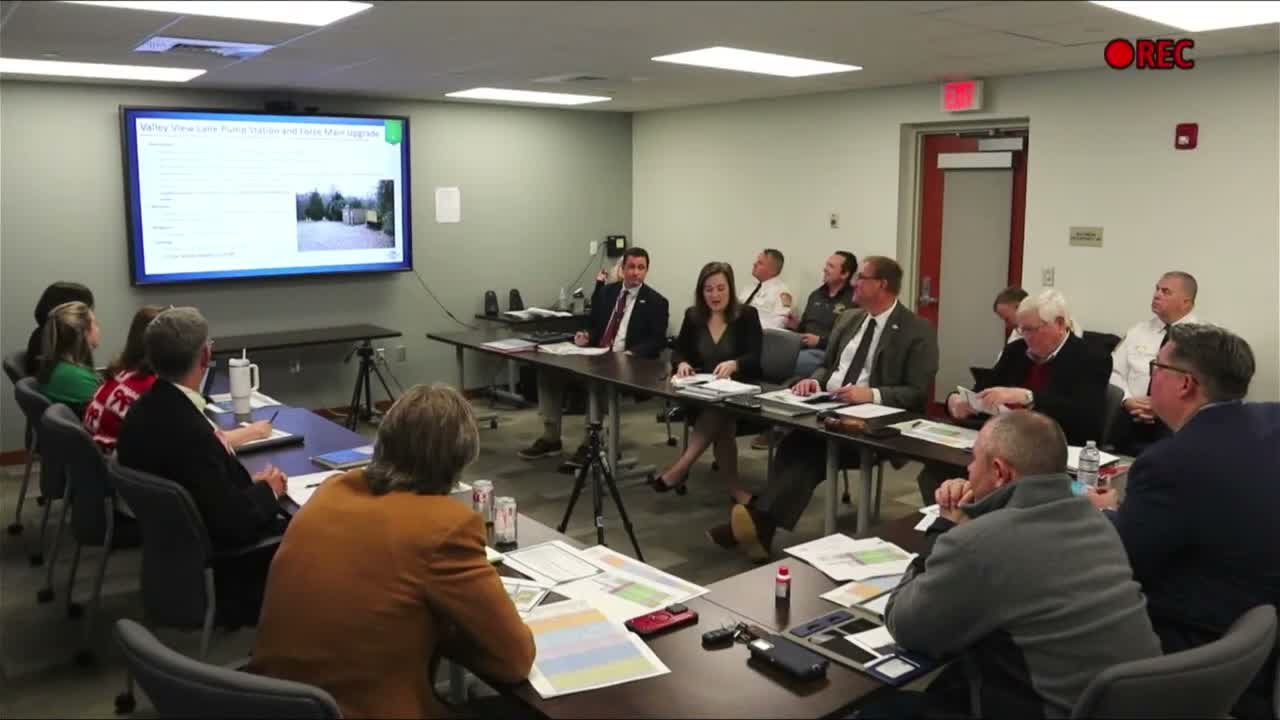
Summary
Staff outlined a package of utility projects including Valley View Lane pump‑station design ($225,000 FY27 request), an EGPS pump assessment ($150,000 FY27), Ridgefield booster and storage (Phase 1 estimated $16.7M), and a Courthouse low‑pressure sewer expansion serving ~75 parcels; county modeling showed a potential 6% residential rate increase if $16.7M is debt financed under current assumptions.
County utilities staff told the Board that several eastern Courthouse‑area utility assets will require near‑term work to support growth and to avoid service failures.
Valley View Lane Pump Station: Elizabeth said the existing station’s firm capacity is 200 gallons per minute but the 2025 master plan projects a peak flow of about 414 gpm by 2030. Staff propose upsizing the station to 580 gpm. The total project estimate is approximately $1.6 million; staff requested $225,000 in FY27 for design and will return for construction funding in FY28. Whether the force main needs upgrading will be decided during design.
Eastern Goochland Pump Station (EGPS): staff said the EGPS conveys Goochland sewage to Richmond and also handles a large pro rata share of Henrico flows. Pumps installed in 2006 are near end of life; staff requested $150,000 in FY27 to perform a pump‑condition assessment to determine repair, replacement or addition of pumps.
Ridgefield booster and storage: Elizabeth described Phase 1 as a 4,000,000 gpd booster station with a 1.5 million gallon ground storage tank; the preliminary engineering report (May 2025) moved the previously planned schedule earlier. Total project cost inclusive of design, land acquisition and construction is estimated at ~$16.7 million; staff noted prior partial funding and a large FY28 funding request tied to the booster/storage item. Board members paused to discuss funding mechanisms (utility fees, general fund, debt financing, connection fees) and asked staff to return with financing scenarios.
Courthouse low‑pressure sewer: staff described a low‑pressure collection system to extend sewer service to approximately 75 parcels in the Courthouse Village area; the project was partially funded in FY26 ($525,000) and staff do not request FY27 funding but estimate additional FY28 needs of roughly $325,000 to finish phase one.
Rates and modeling: county finance and DPU staff ran a financing scenario that assumed debt financing of the Ridgefield booster package ($16.7M) at a conservative 5% interest rate; the model showed peak debt service near FY29 and estimated that spreading this financing across both water and sewer customers could equate to about a 6% residential rate increase under the current assumptions. Staff emphasized the analysis is preliminary and will be refined in the master plan and rate study work.
What’s next: staff will present the 2025 utility master plan in January and return with refined budgets, design scopes and financing options, and requested direction from the Board on funding priorities and whether to pursue debt financing vs. pay‑as‑you‑go approaches.